Monday, November 30, 2015
2015 HONDA CBR650F Review

2015 HONDA CBR650F Review
Honda's CBR650F offers a more viable and moderate four-barrel middleweight sportbike option to today's track-centered 600cc supersports. The CBR650F wraps race-motivated styling around a much more loose riding position than that of a contemporary supersport, and its DOHC fluid cooled inline-four motor is tuned for extremely direct, simple to-oversee power conveyance also.
Best of all, this all-new model conveys a $8,499 MSRP (an ABS model offers for $500 more), which is around three thousand short of what a Cbr600rr.

The easy to use CBR650F houses a totally new motor in an all-new steel edge outline. Expense sparing measures are obvious in the ordinary 41mm non-movable fork and stun, which offers a simple to-utilize sloped spring preload agent. Indeed the twin-cylinder front brake calipers on this new Honda are of the single-activity, pin-slide assortment found on numerous other deal bicycles.

Don't permit any of this to put you off. In the event that country terrace game riding is in your playbook, the CBR650F conveys available corner-cutting execution. Skeleton adjust and taking care of soundness are sublime, the CBR650F mixing impartial controlling and tight suspension with great knock agreeability. The brakes give all the force you require in frenzy stops or charging the corners of a twisty street.

Grip force is uncannily light, which supplements a smooth six-velocity gearbox. Motor vibration stays quelled at lower revs, just turning into a bit buzzy in the bars over 7,000 rpm. Under ordinary riding conditions, there truly is no compelling reason to turn this motor over 7,000 rpm on account of its liberal spread of torque.
I discovered riding this new CBR to be reminiscent of Honda's CBR600F4 of 10 years back, beholding over to a period when expansive centered supersports won races and the hearts of regular riders. Interestingly, I pulled up a dyno diagram of the Autotic Ten Best-winning F4 and found the CBR650F produces upward of 10 pound-feet more torque over the base a large portion of the rev range. It merits in any event a decent specify!

While title winning Cbrs of yore may not have been viewed as passage level bicycles in their day, the new CBR650F, by cutting edge models, speaks to a suitable decision for riders of differing capacity. It's a demonstration of this present Honda's uncanny refinement, rideability, and execution esteem.

Sunday, November 29, 2015
2015 Honda RC213V-S Review

2015 Honda RC213V-S Review

Tragically, Honda did not give any particular specialized insights about the RC213V-S, saying just that it was enlivened by, and created from Honda's hustling project. We can, notwithstanding, make a few suspicions focused around the racebike.
The motor is a 1000cc V-4, much the same as the Motogp racer, however it stays to be perceived how nearly the motors look like one another. Like the race bicycle, the RC213V-S is outfitted with Ohlins suspension and Brembo brakes.
Outwardly, the RC213V-S takes after the race model, aside from with the expansion of road lawful bits, for example, headlights, taillight, turn signs, permit plate holder and bar-end mirrors.

Honda did not give a course of events to when the RC213V-S will enter creation, however it focused on it won't be a swap for the CBR1000RR as the organization's principle literbike rival. Honda did let us know that the RC213V-S will be accessible in the U.s. Estimating will probably be in abundance of $100,000.

Thursday, November 26, 2015
Honda SL350 History : The Stopgap Scrambler !
Honda SL350 History : When Yamaha stirred it all up back in 1968 with the DT1 250 trail bike the future of motorcycling took a very specific and divergent turn. The days of making a half-hearted attempt at an off-roader were over.

Honda’s immediate response was actually little more than a papering over-the-cracks exercise; it might even be seen as a cynical effort. The first Honda SL350 really was little more than a CB350 in a pretty summer outfit. The bike’s mass at 364lb (165kg) meant it was still far too heavy for its intended purpose: Honda arguably still hadn’t quite grasped what a trail bike actually was and was still too focused on the desert sled side of things as successfully capitalised on by the big Brit twins.
The CB’s geometry meant that the ‘new’ SL had too much understeer on fast bends and the power came in a little too hard at 5.000 RPM. The bike was okay but not exactly what the market wanted; there was too much CB about the bike; it even retained the roadster’s electric start. However, there were two facets of the Honda SL350 Motorsport that everyone seemed to love; the looks were stunning and the saddle was one of the most comfortable ever.

With customer feedback taken on board, Honda’s 1970 offering was an altogether better machine. If the Honda SL350 K1 wasn’t a totally all-new machine it was pretty damn close. The heavy single down tube frame had been dropped in favour of a purpose-built lightweight twin down tube chassis; this helped drop weight by an astonishing 60lb (27kg). Smaller slide carbs had replace the previous 30mm CV units, which had had a nasty habit of slamming shut when landing from higher jumps – never the ideal scenario on the dirt! The electric foot was also dropped.
A heavily revised camshaft allowed for maximum torque to be delivered at a much more reasonable 6.000 RPM and although the peak power had dropped from a claimed 33 to 25 HP the motor was much more usable. Revised frame geometry, increased trail, redesigned forks and different shocks all contributed to make the Honda SL350 K1 the bike the K0 should have been. Smaller diameter brakes more in-keeping with the bike’s intended use pretty much completed the upgrade and Honda was onto a winner. There were a host of minor revisions in 1972, including the fitment of a 21in front wheel in place of the previous 19in unit, revised paintwork and the adoption of anodised alloy guards in place of the previous painted ones.

This, the K2, was the end of the line for the Honda SL350. The Japanese had taken a longer term view and realised that it was simply not viable to run an essentially compromised design based on a road bike in a rapidly expanding market sector. Late 1972 saw the launch of the purpose-made XL250 Motorsport. This single re-established the genre that had pretty much died out during the death throes of the British bike industry and arguably it would lead to such ground-changing dirt bikes as the seminal Yamaha XT500.
Honda SL 350 Specifications
Engine : Air Cooled, Four Stroke, Twin-Cylinder, SOHC 4-Valve
Displacement : 326 cc
Bore x Stroke: 64 x 50.6 mm
Compression Ratio : 9.5;1
Carburetion : 2x 36mm Keihin CV
Max Power : 33 HP @ 9.500 RPM
Transmission / Drive : 5-Speed / Chain-Driven
Weight : 165 Kg
Front Suspension : Telescopic Fork
Rear Suspension : Dual-Shock
Front Brakes : Drum
Rear Brakes : Drum
Front Tyre : 3.00 - 19
Rear Tyre : 3.50 -18
Wednesday, November 25, 2015
New Honda Scoopy Scooter Matic 2010

One of the latest motor products are Honda Scoopy 2010 that might rival the Suzuki Titan who was the production of Suzuki and Yamaha also compete with the production of the Xeon 2010 is Yamah.
Apparently if it’s true that later launched the Scoopy, AHM will provide this new motorcycle prices at an affordable price and below the selling price of Vario.
While to outward appearances, Scoopy born with the body is very seductive. A rounded body design coloring almost all parts of the motor, either in the body, the main lights up in the rearview mirror.
This design makes it look very fresh so it can be a choice between the current motors that want to look futuristic. Young people also likely to be tempted and become targetnya.on 125 cc.

Specification New Honda Scoopy 2010
- Transmission: Automatic, V-Matic
- Clutch: Automatic
- Length x width x height: 1844 x 699 x 1070 mm.
- Wheelbase: 1240 mm.
- Lowest distance to the ground: 150 mm.
- Weight empty: 94 kg
- Type order: Vertebra
- Type front suspension: Telescopic
- Type of rear suspension: Single Shockbreaker
- Front tire size: 80/90 – 14 M / C 40P
- Rear tire size: 90/90 – 14 M / C 46P
- Brakes Front: Hydraulic Disc + Single piston
- Rear brakes: Tromol
- Volume step: 108 cc.
- Compression ratio: 9.2: 1
- Maximum power: 6.09 kW (PS 8:28) / 8000 rpm.
- Maximum torque: 8.32 0.85 N.m kgf.m/5.500 rpm.
- Starter: Electric starter & kick starter
- Headlights: 12V 32 W x 1
- Dusk lamp: 12V 5 W x 1
- Accu: MF battery, 12 V – 3 A.h
- Spark plugs: ND U24EPR9, NGK CPR8EA-9
- Ignition system: DC – CDI, Battery
- Carburetor: VK22×1
- Fuel tank capacity: 3.5 liters.
- Engine lubricating oil capacity: 0.7 liters
- Engine type: 4 stroke, SOHC
- Cooling System: Air Cooling fans
- Diameter x measures: 50 x 55 mm.
The plan, motorcycle retro genre will be launched on May 20, 2010 came the invitation to come after the launching of a new motor from AHM.
Scoopy’s outer appearance is very tantalizing and retro-style design that sangta strong with a rounded body coloring almost all parts of the motor, either in the body, main lights up in the rearview mirror.Scoopy view this course will tempt many people, especially young children who like style.
Honda Scoopy in Indonesia seemed to be slightly different from the existing Scoopy in Thailand there. Because when in Thailand Honda Scoopy sell pengabutan injection system, in Indonesia will use a carburetor as pengabutannya system. New Honda Scoopy Motor Scooter Today
Monday, November 23, 2015
Honda CBX 250

Honda is coming up with 250cc motorcycle in India. As per sources Honda has already completed the R&D work and the bike is going to be launched after couple of months probably at the Diwali session. Currently the 250cc bike segment is being ruled by the only bike available- Kawasaki Ninja 250R which was launched recently and it seems like HMSI is not in a mood to miss the opportunity to give competition to this bike to be called as the only competitor of Kawasaki Ninja 250R on Indian roads.
As it is Kawasaki Ninja 250R is not in budget of many bike enthusiasts who are interested in 250cc category and Honda is going to tame that market by offering much cheaper 250cc bike as compared to Ninja, if sources are to be believed Honda is going to price the new bike under Rs.1.5 lacs, which is a very attractive figure for a 250cc milled bike, that too with world class quality & commitment of Honda.
Apart from expected price and expected time of launch it is not known whether the bike will be a naked- sportster version or a fairied version from Honda. Although what ever will be the form of the bike one thing is sure that it will be the performance bike from Honda’s stable and will definitely quench the thirst of performance biking lovers in all ways
Friday, November 20, 2015
Honda CB72, Living The Dream...
Honda’s CB72 – or Dream Super Sport – is one of the most important bikes ever built by the Japanese giant. And it did it while still a teenager...

The young guy on the modern 125cc race-replica didn’t back off the throttle as he went screaming past the stationary CB72. He barely gave the Honda a second glance, and if he had done he probably wouldn’t have been impressed. To most people this was just some old bike with a shiny, chromed petrol tank; and a rider who was jumping up and down on its kickstarter in an attempt to get it running.
A few moments later the twin-cylinder motor fired up and I roared off in pursuit, with a half-formed plan to catch the newer bike and restore the ageing Honda’s honour. It was no use, of course; he’d long since disappeared into the distance. But if ever there’s been a small-capacity roadster that deserves respect from a modern-day motorcyclist – especially a young guy in a hurry – it’s the Honda CB72.
Honda’s Game Changer

This 247cc Honda parallel twin from the Sixties might not look very fast and exciting in comparison with a modern, fully-faired CBR300R, at least if you’re a teenager. But it’s no exaggeration to say that not only was the CB72 the best small-capacity sports bike of its day, but that half a century later it is right up there with the CB750, VFR750 and CBR900RR FireBlade as one of the most significant models that Honda has ever built.
That humped, chrome-plated tank with its rubber knee-pads looks quaintly dated now, but when the CB72 reached Britain and other export markets in the early Sixties its style and specification were a big step forward. This was the bike that proved Honda was getting serious; the first Japanese machine with enough performance and street cred to appeal strongly to European enthusiasts.
Honda had already begun making a big name for itself on the world’s racetracks. In 1961, just two years after the firm’s first, exploratory attempt at the TT, Mike Hailwood and Aussie Tom Phillis won the 250 and 125cc world championships. The following season Honda retained both, and added the 350cc title for good measure.
But although Honda’s twin-cylinder racers – inspired by the German NSUs that had impressed Soichiro Honda during his earlier TT visit – were fast and competitive, the same couldn’t be said of the firm’s roadsters.
Models such as the 250cc C71 – which became the first Honda twin seen in Europe when it arrived in 1959 – were well engineered and reliable. But with its huge mudguards, pressed-steel frame, leading-link forks and rectangular-section shocks, the C71 was heavy and pretty ugly. It was also slow, and didn’t handle particularly well.
The CB72 – known as the DreamSuper Sport in this country and the Hawk in the States – was very different. This was the sporty version of the year’s three-model 250cc range, which also consisted of the basic C72 and dual-purpose CS72.
It had low, flat handlebars, a relatively thinly padded dual-seat, and an innovative instrument panel incorporating a speedometer and rev-counter whose needles rotated in opposite directions. There was even a degree of adjustability in its footrests, which were respectably high and rear-set.
All three 1960 models retained the previous year’s SOHC engine layout, plus dimensions of 54 x 54mm, and switched from dry- to wet-sump lubrication. In addition the CB72 had a 180º crankshaft instead of the C72’s British-style 360º set-up. It also had twin carbs instead of just one, and a higher 9.5:1 compression ratio that helped increase maximum output by 4bhp to 24bhp at 9000 RPM.
The CB72’s chassis changes were even more important. In place of the pressed-steel frame retained by the C72, the sports model had a new and more rigid construction – based on that of Honda’s works racers – combining a tubular-steel main spine with short twin down-tubes leading to the cylinder head.
The old-style leading-link front suspension was replaced by telescopics, with a pair of conventional round-section shocks at the rear. Both front and rear brakes were of high spec: finned, eight-inch diameter twin-leading-shoe drums.
That all gave the CB72 a much more racy and modern look, and riding it did not disappoint. As US mag Cycle World put it at the time:
"Rider position is of necessity very ‘Mike Hailwood’, and although it looks ferociously uncomfortable for touring, the controls and the seat are positioned in such a way that it is, in fact, quite good. In any case, the combination makes the rider feel as though he is very much a part of the machine – and it is fun to drop into a crouch and bare your teeth at other riders as you go by."
The gap between the top two ratios necessitated an occasional tread down into third on uphill stretches, prompting some contemporary testers to suggest that the bike would have been improved by a five-speed box. But they didn’t complain about the CB72’s performance.
The Motor Cycle speed-tested it at an average of 89mph, with a one-way best of 91mph, and said: “The Dream Super Sport is far and away the fastest production two-fifty yet tested. It would hold 70-75mph for the entire length of the M1 motorway with the rider normally seated.” That was impressive stuff, though less so than it would be now, because in 1961 the newly opened M1 was only 60 miles long!
Handling was good, too, in contrast to that of the CB72’s heavier and less well equipped forebears. Cycle World described the Honda as “stable and fast cornering”, adding that “fork angle, trail, spring rates and damper settings are near-perfect, and even a fairly timid rider will find it very natural to ride faster and lean over farther than is his habit to do.”
Building the Brand

Back in the early Sixties the Honda impressed not only with its speed and handling but with its quality and reliability. As the Motor Cycle put it:
“Have racing successes any bearing on production quality? Does racing really improve the breed? that the answer to both these questions is a decided ‘yes’ is immediately obvious ! That a machine of such full blooded performance should at the same time be so unobtrusive and docile reflects tremendous credit on a firmfounded only 13 years ago.”
The CB72 made an excellent impression with almost everyone who rode one, and did much to increase the respect with which Honda was regarded in many countries. It was followed in 1963 by a 305cc version – the CB77 – which was good for a genuine 95mph and had “performance that would do credit to a 500”, according to one report.
Lingering anti-Japanese prejudice combined with a high price to ensure that the CB72 didn’t sell in vast numbers. In 1962 it cost almost £300 when Ariel’s 250cc Sports Arrow was priced at £190. But the twin made a strong impression, and was much loved by many of its owners. Most importantly, the CB72 proved that Honda could make fast, fine-handling, stylish bikes that appealed to enthusiasts all over the world – much as they’ve been doing ever since.
What’s It Like to Ride?
Aggressive riding comes naturally to the pilot of a CB72, as I soon discovered after setting off on this very original machine, borrowed from specialist Oxford Classic Honda. With 13,000 miles on the clock the 1967-registered bike looked in good, unrestored condition.
Its distinctive speedo face was slightly faded, while the chrome and paintwork had a few minor marks and rustspots, but generally the Honda had aged well. It had been borrowed on short notice, and not run for some time, which explained its reluctance to start on the button, due to a weak battery. But the air-cooled motor generally fired-up easily enough after a few leaps on the unusual kick-starter, which swung forward rather than backwards when I applied my boot to it.
Once under way the Honda soon confirmed that its character was pretty much as you’d expect from the sporty riding position and the tacho’s 9000rpm redline. Revved hard, the CB72 performed well enough to make me realise why it had so impressed testers and owners alike back in the early Sixties.
There was a notable flat-spot at 4-5000rpm, almost certainly due to this bike’s carbs being in need of a cleanout due to the bike having been standing for a while. Then the motor got into its stride, revving smoothly with a dull drone from the low-set twin pipes. Soon I was barrelling along at 70mph, leant comfortably forward into the breeze, and with plenty of speed in hand. At that pace the engine wasn’t even particularly stressed, because top gear in the four-speed box was quite tall. Even so it was easy to understand those contemporary testers’ desire for a fifth cog.
The Honda was quick enough to be plenty of fun, and it also went round corners well for a small and elderly machine. Its suspension was reasonably firmand welldamped, even at the rear where the shocks didn’t make me want to replace them with a pair of Girling units, as some hard-riding owners did in the Sixties. At 153kg dry the CB72 was light even by modern standards, and was stable enough to encourage me to flick it around.
The only aspect of the chassis that disappointed was the twin-leading-shoe front drum brake, which was regarded as excellent in its day, but in this bike’s case was rather spongy and ineffective. New and freshly set-up shoes would doubtless have helped.
At least the lack of stopping power meant there was no danger of overwhelming the skinny, 2.75-section front Avon tyre.
Wednesday, November 18, 2015
2016 New Honda CBR500R Update !
Honda shows the refreshment form of their Middleweight Sportbike, CBR500R. Some of the latest features also added to the 2016 New Honda CBR500R.

As well as new edgier design, the latest features are also added in the 2016 New Honda CBR500R, such as Adjustable front suspension, Larger gas tank, New Hinged Fuel Cap, the brake lever that can be adjustable as well, New ignition key, and also shorter exhaust muffler that tuned for a satisfying low, crisp exhaust note, and more pleasing to the ear.
This 2016 New CBR500R was first exhibited at the American International Motorcycle Expo in Orlando, Florida, USA on October 15, 2015. The Mid-range CBR Sportsbike prepared for the novice rider, or a veteran rider who is looking for comfortable riding on a sportbike.


The styling refers to the flagship design CBR1000RR Fireblade. "'Aggressive Speed Shape' is a concept style of the New CBR500R," wrote Honda. For lights, this new Baby CBR will use dual LED headlight that is also combined with the LED tail lights. This bike will be launched in US next year. Honda also had planned to sell this bike in North America, Europe, Asia and Japan too.
Tuesday, November 17, 2015
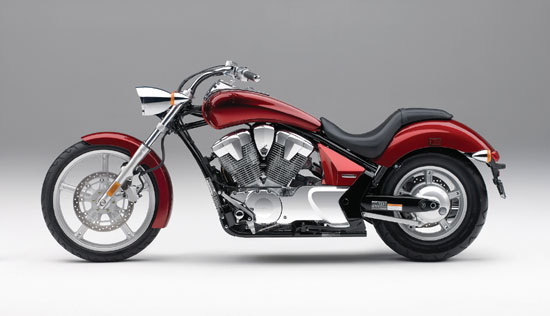
Honda VT1300CS Sabre motorcycle in Houston-2010

Long, Low, Lean and Mean.
• Raked-out front end.
• Asphalt-skimming saddle.
• Fat rear tire.
• Looooong wheelbase.
• In other words, Pro Street styling from tip to tail.

Features/Benefits
• New muscular pro-street styling with a raked-out front end for an aggressive stance and stylized curved frame downtube create a unique custom look.
• New bars are low, narrow and set forward for an aggressive pro-street riding position.
• Minimalist front and rear fenders plus a sleek one-piece seat enhance the Sabre’s bold design.
• Specially designed tank-mounted chrome housing features a speedometer
• 1312cc liquid-cooled 52-degree V-twin delivers strong low-end and mid-range torque, with ample power for passing and relaxed cruising. Unique dual exhaust offers throaty exhaust note.
• Boulevard Screen (tinted), Backrest and Pad (low/tall-narrow), Backrest and Rear Carrier Mounting Brackets, Leather Saddlebag (24L-plain/studded), Synthetic Saddlebag (18L-plain/studded), Saddlebag Bracket, Tank Belt (plain/studded), Rear Carrier, Custom Grips, Passenger Floorboard, Oil Dipstick, Engine Guard, Custom Footpeg, Lower Cowl Spoiler, Chrome Sidecover, Driving Light (PIAA Type), Throttle Cable (braided).
2010 Honda VT1300CSA Sabre.
Engine
Model: VT1300CS / VT1300CSA ABS
Engine Type: 1312cc liquid-cooled 52° V-twin
Bore and Stroke: 89.5mm x 104.3mm
Compression ratio: 9.2:1
Valve Train: SOHC; three valves per cylinder
Induction: PGM-FI with automatic enrichment circuit, one 38mm throttle body
Ignition: Digital with 3-D mapping, two spark plugs per cylinder.
Transmission: Five-speed.
Suspension Front: 41mm fork; 4.0 inches travel
Suspension Rear: Single shock; 3.9 inches travel
Brakes Front: Single 336mm disc with twin-piston caliper
Brakes Rear: 296mm disc with single-piston caliper; Optional ABS and CBS available in Black color only.
Tire Front: 90/90-21
Tire Rear: 170/80-15
Thursday, November 12, 2015
2015 Honda VFR800X Crossrunner Preview

The Honda Vfr800x Crossrunner emphasizes noticeably in practically any talk of cool bicycles that don't make it to the U.s. For those not officially aware of present circumstances, the first Crossrunner has been sold abroad since 2011. We noted its EICMA make a big appearance in 2010 and quietly crossed our fingers with the expectation that this Vfr800 encircled yet changed over to a more upright, utilitarian situated Naked bicycle would see time in our carports – without any result.

When we first heard bits of gossip about an upgraded Crossrunner for 2015, we reached our sources inside American Honda and were educated generally, "Definitely, we heard concerning it, as well, and no, we don't know whether its impending stateside." Now, Honda Europe has made that showcase's redesign official.
Perusing through the rundown of upgrades just assists our yearning to toss a leg over the snappy adventuresque bare bicycle. For 2015, the VTEC-prepared 90° V4 DOHC 16 valve motor gets a knock in torque where it matters – in the low- to mid-range. Clearly, this didn't take a stab at the cost of the top end with is asserted to be 105bhp at 10,250rpm.

The motor isn't required to be the main change. The aluminum twin-shaft casing will get a reexamined subframe. The suspension travel will be knock a bit: 25mm in advance and 28mm in the back. ABS will be standard on 17-inch empty cast aluminum wheels. Wrapped around the wheels are a 120 front tire and 180 back. The 310mm plates will be grasped by spiral mount, four-cylinder calipers.

Honda Selectable Torque Control (HSTC) will perform footing control obligations by decreasing torque to the back wheel on the off chance that loss of back wheel hold is sensed. The framework has two settings notwithstanding off to permit riders to tune the HSTC to their tastes. Preceding moving to the Crossrunner, the framework has been a piece of the Crosstourer for 2014 model year.

Different peculiarities incorporate Honda's Selectable Torque Control (HSTC) framework, ABS, LED lights, wiping toward oneself out pointers and warmed grasps as standard.
Will the Crossrunner make it Stateside? We can simply dream
2015 Honda CRF450R First Ride Preview


2015 Honda CRF450R Specifications
Msrp $8699
Motor Type 449cc fluid cooled single-barrel four-stroke
Bore and Stroke 96.0mm x 62.1mm
Squeezing Ratio 12.5:1
Valve Train unicam, four-valve; 36mm admission, titanium; 31mm fumes, steel
Induction dual-Timing PGM-FI, 46mm throttle body
Ignition full transistor with electronic development
Transmission close-degree five-rate
Last Drive #520 chain; 13t/48t
Front Suspension 48mm transformed KYB PSF (Pneumatic Spring Fork) with air-flexible spring rate, and bounce back and layering damping flexibility; 12.2 inches travel.
Back Suspension pro-Link® KYB single stun with movable spring preload, bounce back damping flexibility, and layering damping alteration differentiated into low- speed and fast; 12.4 inches travel
Brakes
Front single 260mm wave-style plate with twin-cylinder caliper
Rear single 240mm wave-style plate
Tires
Front dunlop Mx52 80/100-21
Rear dunlop Mx52 120/80-19
Wheelbase 58.7 inches
Rake 27° 04'
Trail 116mm (4.6 inches)
Seat Height 37.5 inches
Ground Clearance 13.0 inches
Fuel Capacity 1.7 gallons
Color red
Guaranteed Curb Weight* 243.0 poun
Reviews :2015 Honda CRF450R First Ride
Wednesday, November 11, 2015
2015 Honda Nm4 Preview

2015 Honda Nm4 Preview
Man, I need so severely to like this thing, given that it is by all accounts my mission in life to grasp the Weird. In any case this Honda isn't even all that bizarre, not when you come close it to blue-sky shots like the old Pacific Coast (which has accomplished religion status) or the abnormal Rune, or even the Fury chopper – which is a thing I never thought I'd see Honda manufacture. On the other hand, its really out there: No bicycle I've ridden before lights up the wild-peered toward road individuals of the OC very like this one.
The Nm4 is immaculate stealth warrior/ Batman meets Capt. Nemo, however its not a radical flight from the DN-01 lemon, and its not very elaborately expelled from the enormously mainstream (in Japan in any case) Helix bike. What it has pulling out all the stops that not one or the other of those do is the fantastic motor and Dual Clutch Transmission from one of my current most loved cruisers – Honda's Nc700x (and the not really most loved Ctx700). The thrusty, undersquare 670cc parallel-Twin hid and forward, insincere its barrels at a 62-degree point in the steel-tube edge, making for a low bike and a long one, with a wheelbase of 64.7 inches.

Low But Not Slow
Actually, its for the duration of the about and low: The seat's sufficiently low to make you feel like Batman riding a supine bike, even several inches lower than the Ctx700's, however the Nm4's floorboards don't make your legs need to extend so far forward as the Ctx's. An alternate pleasant touch is a traveler situate that flips up to serve as a three-position tightening flexible backrest – a truly decent thing to have when you ratchet up the rate on a supine bicycle like this one.
For a thing that by and large feels like a congested bike around town, the NM is additionally truly upbeat to go as quick as you set out. Air spills sensibly neatly over the Adams-apple-stature windscreen, contingent upon wind heading and pace, and the front automatic rifle mounts/ mirror cases immediate air around your hands. Alongside the standard warmed holds, the Nm4 may not be a terrible bicycle to end up upon in frosty climate. When its hot, however, which it was the point at which we had the bicycle, the bodywork likewise does great work keeping motor high temperature under control.

Taking off from a green light in Sport mode, the NM leaves all autos in the dust and feels like it would be a definitive reliable section racer, making clean, exact movements at around 6000 rpm against all odds: In this motor, 44 stallions feels like more on account of all the torque the Twin creates down low. We didn't get the NM to the dyno, yet it ought to be near to the Ctx700n tried in our Millennial Hep Cat Shootout a month ago. Its torque bend isn't much of a bend, beating 40 ft-lb by 3300 rpm before topping at 4900 rpm at 41 ft-lb. In the event that you were Batman, it would be no issue to shoot different types of weapons precisely with your left hand, so smooth are the DCT shifts. Then again, the space between the handlebar risers shouts out for a decent warm espresso glass/ ipod mount. I'm Batc
Stealthy Fast

The Nm4 isn't let around its frame: 43mm fork tubes (2mm greater than NC or CTX) raked out at 33 degrees keep the directing super-steady at expressway speeds, additionally light-guiding in moderate going. Eighty-five-mph road bridges that have bicycles like the Guzzi V7 Stone feeling a bit weavy/crude are totally censured down on the Nm4, which covers knocks well and is not your father's Batmobile.

2009 Honda DN-01 Review
A right-thumb punch is everything you need to change from D to S to dial up more mid-corner speed, and you'll be convey genuinely lively speed before the antennas on the floorboards and the external edges of your shoes touch down (no flip-flops in case you're striving for the zeal!), not elbow-dragging cornering freedom, yet not in any way terrible. A 18-inch front outspread and a 200/50-17 back join custom looks with a present day ride and footing; 3.9 inches of decently damped go at both closures get on with the current task without protest and no bottoming with my 155-pound body.
Brakes are similarly unremarkable on the spec sheet, yet truly skilled out and about: The 320mm front plate isn't awfully compelling, however joined with the 240mm back, the Nm4 can be made to clean speed truly rapidly; both finishes get ABS yet are not connected. The raked-out front, long wheelbase and lowness of the thing all support brisk decel when its called for.

Is That All There Is?
I assume my huge bafflement with the Nm4 is that from the minute I looked at it, I expected it was going to have genuine capacity limit. Oh, opening what seem, by all accounts, to be great estimated saddlebags rewards you with sleeved-down pockets that'll fit around one little watermelon; not in any case Victoria's Secret makes cushioned brassieres as outwardly deceptive as the Nm4's packs.
Furthermore the left one has a 12v outlet, which is great, on the grounds that your phone is about the main thing that will fit in it. Little. Honda needs to turn it as a little stockpiling limit is superior to none, keeping in mind that is genuine, the entire thing abandons me with a bit of a Crying Game completion; I feel misdirected. Batman needs to convey some stuff; the Nm4 offers no more limit than the tool cinch. Possibly I expect excessively…
Talking about little limit, Honda's specs say the fuel tank holds three gallons, yet you're down to one flickering bar on the LCD gage at 110 miles. In blended utilization, we watched 55 mpg, which ought to bring about 165-mile range, however I was never overcome enough to push past 130 or thereabouts with the gage demanding we're outta gas. Why not fill the empty space around the saddlebags with a hundred gallons of fuel? (Mockery)

Concerning me, it primarily fills the same need as the Ctx700 – to remind me the extent to which I truly like Honda's Nc700x, a bicycle that improves everything and less expensive, and will even clutch your cap for you in its huge locking compartment while you pop in for another knocking down some pins ball or goat head or box of modest wine, which it will then helpfully transport.

Toward the end of the day, however, the NM is similar to a considerable measure of things looking for a corner: If you're a short-legged Goth (do we have those any longer?) with a Christian Bale obsession and the cost of affirmation, you'll adore the Nm4. Simply recollect, capes and bikes don't generally blen.
Tuesday, November 10, 2015
2015 Honda CB300F Preview

When we were introduced to the 2015 Honda CBR300R at its recent press introduction at Honda’s headquarters in Southern California, Honda reps teased us by displaying the 300R’s naked sibling, the CB300F, alongside it. We weren’t able to ride it, but there it sat, ready for the assembled press to sit, ogle and stare. Thankfully, Honda didn’t keep us waiting for long, as only weeks after I rode the fully faired 300R, we were given a 300F to throw around.
Less Is More
Judging the CB300F and CBR300R based on outward appearance really does reveal the difference between the two. Start with the latter, shed nearly all of the bodywork ahead of the engine, ditch the dual headlights for a single lamp, then swap the clip-ons for a handlebar and you’ve got the former. Otherwise, the two bikes are identical.

2015 Honda CBR300R First Ride Review
That is to say the 300F shares the same frame, wheels, brakes, tires and suspension as the 300R. Of course, both bikes also have the liquid-cooled, 286cc counterbalanced Single in common, too. Itself being simply a stroked version of the 249cc DOHC, four-valve engine first seen in yesteryear’s CBR250R. For full details on the CBR300R, click the link above to read all about it.
Honda claimed a 17% increase in power over its predecessor, and after running our 300F on the MotoGP Werks dyno in Anaheim, California, those claims appear to be spot-on. With 26.2 horses at 8500 rpm, our test bike put out exactly 17% more power than the last CBR250R we tested (22.5 hp). Torque output is 17.4 ft-lbs at 6800 rpm. Not mind blowing, but respectable in the class and also 17% greater than the 250R.
“My first ride aboard the CB300F awakened me to the fact that the little Honda has considerably more oomph compared to the bikes against which we were testing in our forthcoming Lightweight Nakeds shootout,” says Content Editor, Tom Roderick.

When all is said and done, the 300F comes in 9 lbs lighter than the R model and also sheds some weight on price. Starting at $3999, it’s $400 cheaper than the R.
From The Saddle
As one would expect, riding the Cb300f isn't excessively unique from the Cbr300r. The undeniable distinction being the measure of forward tilt the rider encounters. While the 300r has the rider marginally slouched forward to snatch the cut ons, the 300f's pilot is welcomed to an a great deal more unbiased position on account of the upright bars.
One of the decent parts of the single-barrel motor, particularly for more up to date riders, is its slender measurements. This helps keep the rider's legs from spreading too far separated once on the bicycle, yet despite the fact that the 300f's 30.7-inch seat stature is humble, the slenderness of the seat/gas tank intersection supports shorter riders in planting both feet on the ground. For reference, my 30-inch inseam had no issues immovably getting both feet on landing area.
Grip draw is light, which ought to give the fresher rider more certainty while leaving a stop. The majority of our analyzers judged the Honda's filling to be blame free, however kickstart-proofreader, John Burns, felt a slight hiccup amid on/off throttle application. The change lever effortlessly moves from gear to apparatus, importance its not just simple to draw far from a stop, yet moving as you get velocity is straightforward, also.

At the same time, we were awed at the relative absence of vibration from the motor. Singles are known to thunder at high motor paces, however Honda has made an excellent showing suppressing vibes on the 300f. Vibes are truly just felt once pushing past 80 mph, and are recognized more in the pegs than the bars. Keep speeds humble, and she's essentially without vibe.
Taking care of from the CB is unbiased, as the bars give great influence to flick starting with one course then onto the next. The 37mm fork and preload-customizable stun are dialed on the delicate side. Along these lines, country byway shelling isn't its forte, yet the rider who stresses smoothness over animosity will be remunerated with an average experience.
About the main thing we could blame from the Cb300f are its brakes. Furnished with a 296mm circle in front and 220mm plate in the back, halting execution was just satisfactory. While positively not terrible, our specific test bicycle had an elastic lever, which I don't recall from the Cbr300r. Some new cushions and steel-interlaced lines would likely go far towards drastically enhancing the 300's halting force.
Bare Learners
From for all intents and purpose the start of time, at whatever point we've been asked what bicycle another rider ought to begin on, we quite often agree with the child Ninja or CBR. Notwithstanding, those days may be arriving at an end. With the Cb300f, riders will get all the execution the completely faired adaptations convey, with some included profits.

To begin with, handlebars rather than cut ons are more agreeable for typical riding, and they make it somewhat simpler for riders to learn tight, moderate pace moves. Second, the 300f expenses short of what the CBR (and Ninja 300). Third, and all the more essentially, the absence of bodywork means the unavoidable tipover won't have as extreme a result. Calculate in the simplicity of upkeep from the absence of bodywork, and the Cb300f draws a solid case for itself as the prime starter bicycle.
Experienced riders will likewise find the CB 300f a fun bicycle. Its relative absence of force will keep them out of inconvenience while at the same time serving as an extraordinary learning instrument for ingraining fitting procedure to keep up velocity. Likewise, consider the almost 60 mpg we came back from our test unit, and riders of all experience levels ought to discover the Cb300f engaging for the day by day grind.