Showing posts with label Motorcycle. Show all posts
Showing posts with label Motorcycle. Show all posts
Sunday, November 29, 2015
Get Fitted Up Your Motorcycle !
Forget any idea of "one size fits all". Your bike has to fit you just right if you want to have precision control. To change down smoothly under braking, your front brake and clutch levers must be positioned right. For smooth starts and slick changes the clutch bite point needs to be set right. A badly set gear-shifter can make you wobble and your changes slow up or down the box. Little things do matter. Even two people the same size may need to set a bike differently to fit differences in arm, leg and trunk lengths as well as riding style and personal preference.
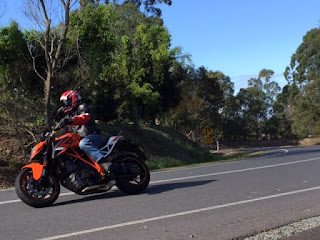
Adjusting the controls "spot on" gives you optimum control with maximum comfort. Each control action does its own job without disturbing balance or weight distribution, in an emergency that can be the difference between staying in control and coming off.
So let’s look at how to do it.
- We want instant braking
- Good "feel"
- Easy throttle blipping for smooth down changes
OK, in your normal ‘at speed’ body posture, reach out for the brake. It needs to be angled so that it "falls to hand". Try it eyes closed. If the lever is too high your wrist will bend up uncomfortably and it will be even worse as you lean back into your braking posture. If the lever is too low, it might feel OK in your sit up braking posture but it won’t fall naturally to hand at speed.
Once you have found the small range of rotation of the lever that feels right for just braking, work on braking and blipping the throttle at the same time. Most times you do this, you will be in sit up posture under firm braking, slowing for a curve, but just occasionally you will want to brake and downshift while maintaining your ‘at speed’ posture. (I find this happens when aborting a passing maneuver and getting ready for the next chance).
Perfect blipping is most critical when under heavy braking because that’s when rear tire is lightly loaded you are most likely to break traction with a bad downshift, so bias your final setting to favor this situation.
Easier than setting the brake lever because your left hand only has one job. For me precision clutch control is most demanding when maneuvering at walking pace, so I want the angle set for that.
The other thing to adjust is the clutch biting point. Two things are important here: low speed maneuvering and quick downshifts at speed. To get quick shifts, I want the clutch disengaged with only a part squeeze on the lever, not have to pull it up to the grip. For maneuvering and stopstart city traffic, you want the ‘just engaging’ point of the travel at the most comfortable and controllable amount of squeeze. Bikes with a heavy clutch or a long, draggy action can be a pain! One thing is for sure, you’ll always ride better with your best compromise setting than the way it came. And if it is still a pain, maybe you should see if there are any upgrades or modifications available for your model.
If you thought adjusting hand controls was fiddly, you ain’t seen nothing yet!
The rear brake is the third control that needs ‘feel’ and feedback to the rider. Motorcycles vary in the pedal pressure and travel that’s needed. You only need enough pressure to squeal, not lock(!), the rear tire at 70mph. The brake may be capable of more than this but you won’t ever be able to use it, even with a failed front brake. If you have the confidence and control to rear tire squeal from 70mph down to 20mph, I congratulate you. You truly are a rear brake maestro. If not, please don’t start practising at 70 mph unless you are feeling suicidal!
Unless you are a maestro already, set your brake for maximum comfort and control when using it fairly gently for low speed work and slippery conditions.
The correct way to make adjustments may not be obvious, check out the manufacturer’s instructions in the manual. Make adjustments a little at a time. Remember that a pedal set too low could reduce ground clearance and the available lean angle. Look what other settings (peg position for example) are available on your model.
There is probably more variation in travel, weight, feel, crispness and adjustment in gearshifts than in any other motorcycle control. Just be glad you are not forced to use hand gear selection that was popular in the old days. Read the manual to see how to make adjustments. Aim to be able to make quick, clean shifts both up and down without repositioning your foot or straining your ankle. Be aware of possible ground clearance issues.
When you reckon you have got the right setting just do a quick check to make sure selecting first at standstill with your other foot down still feels OK. This move is different because you are unbalanced and out of the normal body position. Sports bikes can be a bit awkward and tiring to ride in the city unless you get it right.
I hope you have got your bike set up to suit you now. I promise it will make a major improvement to your comfort and control. As you get familiar with the new feel, give yourself a little time to settle in, but don’t be afraid to make further minor adjustments that get the total package working in harmony.
Setting the bike for precision control is groundwork advanced riding.
Read more »

Adjusting the controls "spot on" gives you optimum control with maximum comfort. Each control action does its own job without disturbing balance or weight distribution, in an emergency that can be the difference between staying in control and coming off.
So let’s look at how to do it.
Set that Front Brake
- We want instant braking
- Good "feel"
- Easy throttle blipping for smooth down changes
OK, in your normal ‘at speed’ body posture, reach out for the brake. It needs to be angled so that it "falls to hand". Try it eyes closed. If the lever is too high your wrist will bend up uncomfortably and it will be even worse as you lean back into your braking posture. If the lever is too low, it might feel OK in your sit up braking posture but it won’t fall naturally to hand at speed.
Once you have found the small range of rotation of the lever that feels right for just braking, work on braking and blipping the throttle at the same time. Most times you do this, you will be in sit up posture under firm braking, slowing for a curve, but just occasionally you will want to brake and downshift while maintaining your ‘at speed’ posture. (I find this happens when aborting a passing maneuver and getting ready for the next chance).
Riding with 2 fingers covering the brake is a recommended technique – but it may require a different setting.
Perfect blipping is most critical when under heavy braking because that’s when rear tire is lightly loaded you are most likely to break traction with a bad downshift, so bias your final setting to favor this situation.
Set the Clutch
Easier than setting the brake lever because your left hand only has one job. For me precision clutch control is most demanding when maneuvering at walking pace, so I want the angle set for that.
The other thing to adjust is the clutch biting point. Two things are important here: low speed maneuvering and quick downshifts at speed. To get quick shifts, I want the clutch disengaged with only a part squeeze on the lever, not have to pull it up to the grip. For maneuvering and stopstart city traffic, you want the ‘just engaging’ point of the travel at the most comfortable and controllable amount of squeeze. Bikes with a heavy clutch or a long, draggy action can be a pain! One thing is for sure, you’ll always ride better with your best compromise setting than the way it came. And if it is still a pain, maybe you should see if there are any upgrades or modifications available for your model.
Set the Rear Brake
If you thought adjusting hand controls was fiddly, you ain’t seen nothing yet!
The rear brake is the third control that needs ‘feel’ and feedback to the rider. Motorcycles vary in the pedal pressure and travel that’s needed. You only need enough pressure to squeal, not lock(!), the rear tire at 70mph. The brake may be capable of more than this but you won’t ever be able to use it, even with a failed front brake. If you have the confidence and control to rear tire squeal from 70mph down to 20mph, I congratulate you. You truly are a rear brake maestro. If not, please don’t start practising at 70 mph unless you are feeling suicidal!
Unless you are a maestro already, set your brake for maximum comfort and control when using it fairly gently for low speed work and slippery conditions.
The correct way to make adjustments may not be obvious, check out the manufacturer’s instructions in the manual. Make adjustments a little at a time. Remember that a pedal set too low could reduce ground clearance and the available lean angle. Look what other settings (peg position for example) are available on your model.
Set the Gear Shift
There is probably more variation in travel, weight, feel, crispness and adjustment in gearshifts than in any other motorcycle control. Just be glad you are not forced to use hand gear selection that was popular in the old days. Read the manual to see how to make adjustments. Aim to be able to make quick, clean shifts both up and down without repositioning your foot or straining your ankle. Be aware of possible ground clearance issues.
When you reckon you have got the right setting just do a quick check to make sure selecting first at standstill with your other foot down still feels OK. This move is different because you are unbalanced and out of the normal body position. Sports bikes can be a bit awkward and tiring to ride in the city unless you get it right.
I hope you have got your bike set up to suit you now. I promise it will make a major improvement to your comfort and control. As you get familiar with the new feel, give yourself a little time to settle in, but don’t be afraid to make further minor adjustments that get the total package working in harmony.
Setting the bike for precision control is groundwork advanced riding.

Thursday, November 26, 2015
Buying Your First Motorcycle : What’s It Worth ?
You’ve found the bike of your dreams, it’s mechanically and cosmetically perfect, and you already have visions of yourself roaming the highways on the beast. Now you have to figure out how much the bike is worth.

There’s not much to negotiating the price of a new bike. Your best bet is to call every dealer within reasonable driving distance (remember, you will probably have to return to that dealer for warranty work) and find out what each one is charging for the model you’re interested in. Once you have the best price, you might want to go to the nearest dealer you trust and give them an opportunity to match it. Even if they can’t match it exactly, if they can even come close, it might be worth a few extra dollars to buy from someone you trust, someone who is located nearby.
When shopping for a new motorcycle, you can save a lot of money by remaining flexible about which make and model to buy. Say you’ve decided to purchase a midsized cruiser, like Kawasaki’s Vulcan 800 Classic. While searching for such a bike, you find a decade-old Honda 800 Shadow in mint condition at one-third the price of the Kawasaki.
While the Kawasaki is a fine motorcycle, the Shadow is capable of providing every bit as much enjoyment, and with its shaft drive and hydraulically-adjusted valves, the Honda will save you hundreds of dollars per year in maintenance costs over the Kawasaki. You can pocket the money saved and use it to finance a cross-country motorcycle trip.
You can also save a lot of money by watching for carryover models. While shopping for the best deal on a Honda 750 Shadow, you might run across a brand-new last year’s model Kawasaki 800 Vulcan for $1,500 less. In this case, maintenance costs will be roughly equal, since both bikes have manually adjusted valves and chain drives, so if you keep an open mind, that will be an extra $1,500 in your pocket.
Buying a used bike is where the process most diverges from buying a car. Because motorcycle prices can fluctuate widely from region to region, depending on how large a market an area has, accurate price guides are difficult to compile.
Further complicating the creation of useful price guides is the wide variation in the condition of each motorcycle. One seller’s Yamaha 1100 Special can be in mint condition at 60,000 miles, while the next guy’s can be a hunk of junk at 10,000 miles. When deciding how much a bike is worth, a guidebook’s value assessment is only part of the equation. In addition to things such as condition and completeness, you have to look at routine wear and tear. Keeping a motorcycle in tip-top running condition is an expensive proposition. A bike with a fresh tune-up is definitely worth more than a bike needing a tune-up.
Another item that increases a bike’s value is fresh tires. You should be able to tell by looking whether the tires have low miles: Check the depth of the tread at the edges of the tire compared to the depth of the tread at the center. A good pair of quality tires can run you well over $300, with mounting and balancing, so factor that into your price determination.
On the other hand, new tires of low quality actually detract from the value of a bike, at least in my personal equation. If a bike has a pair of bargain-brand tires, I have to either make the decision to drive on tires I consider unsafe, or toss out a nearly new set of tires and spend $300 on another pair. If a bike is wearing a pair of budget-brand tires, I automatically deduct $250 from my offer.
It’s a good idea to speak with as many other owners of a certain model as you can before making a purchase (here again, belonging to a club can be beneficial). Also, check any service bulletins that may have been issued to your dealer on a certain model before buying that model.
These rough guidelines may help, but in the end, it’s just going to be you and the seller. The entire process may boil down to how badly you want to buy the bike or how much the owner wants to sell it. One thing I can guarantee: If you buy the motorcycle that’s right for you, one or two years from now, as you’re riding down the road enjoying your machine, you will not be thinking, “Damn, I paid too much for this thing.”
Read more »

There’s not much to negotiating the price of a new bike. Your best bet is to call every dealer within reasonable driving distance (remember, you will probably have to return to that dealer for warranty work) and find out what each one is charging for the model you’re interested in. Once you have the best price, you might want to go to the nearest dealer you trust and give them an opportunity to match it. Even if they can’t match it exactly, if they can even come close, it might be worth a few extra dollars to buy from someone you trust, someone who is located nearby.
When shopping for a new motorcycle, you can save a lot of money by remaining flexible about which make and model to buy. Say you’ve decided to purchase a midsized cruiser, like Kawasaki’s Vulcan 800 Classic. While searching for such a bike, you find a decade-old Honda 800 Shadow in mint condition at one-third the price of the Kawasaki.
While the Kawasaki is a fine motorcycle, the Shadow is capable of providing every bit as much enjoyment, and with its shaft drive and hydraulically-adjusted valves, the Honda will save you hundreds of dollars per year in maintenance costs over the Kawasaki. You can pocket the money saved and use it to finance a cross-country motorcycle trip.
You can also save a lot of money by watching for carryover models. While shopping for the best deal on a Honda 750 Shadow, you might run across a brand-new last year’s model Kawasaki 800 Vulcan for $1,500 less. In this case, maintenance costs will be roughly equal, since both bikes have manually adjusted valves and chain drives, so if you keep an open mind, that will be an extra $1,500 in your pocket.
Buying a used bike is where the process most diverges from buying a car. Because motorcycle prices can fluctuate widely from region to region, depending on how large a market an area has, accurate price guides are difficult to compile.
Further complicating the creation of useful price guides is the wide variation in the condition of each motorcycle. One seller’s Yamaha 1100 Special can be in mint condition at 60,000 miles, while the next guy’s can be a hunk of junk at 10,000 miles. When deciding how much a bike is worth, a guidebook’s value assessment is only part of the equation. In addition to things such as condition and completeness, you have to look at routine wear and tear. Keeping a motorcycle in tip-top running condition is an expensive proposition. A bike with a fresh tune-up is definitely worth more than a bike needing a tune-up.
Another item that increases a bike’s value is fresh tires. You should be able to tell by looking whether the tires have low miles: Check the depth of the tread at the edges of the tire compared to the depth of the tread at the center. A good pair of quality tires can run you well over $300, with mounting and balancing, so factor that into your price determination.
On the other hand, new tires of low quality actually detract from the value of a bike, at least in my personal equation. If a bike has a pair of bargain-brand tires, I have to either make the decision to drive on tires I consider unsafe, or toss out a nearly new set of tires and spend $300 on another pair. If a bike is wearing a pair of budget-brand tires, I automatically deduct $250 from my offer.
It’s a good idea to speak with as many other owners of a certain model as you can before making a purchase (here again, belonging to a club can be beneficial). Also, check any service bulletins that may have been issued to your dealer on a certain model before buying that model.
These rough guidelines may help, but in the end, it’s just going to be you and the seller. The entire process may boil down to how badly you want to buy the bike or how much the owner wants to sell it. One thing I can guarantee: If you buy the motorcycle that’s right for you, one or two years from now, as you’re riding down the road enjoying your machine, you will not be thinking, “Damn, I paid too much for this thing.”
Tuesday, November 24, 2015
Buying Your First Motorcycle : What to Look For ?

Buying a used motorcycle seems something of a crap shoot to the uninitiated. Judging a dependable bike from a pile of junk may appear difficult to the first-time buyer, but a couple of basic motorcycle characteristics make it easier than you might think.
First, motorcycles have nothing to hide. If a frame has been repaired, you will see welds or cracks in the paint. If the bike leaks fluids, those fluids will ooze out before your eyes.
Second, there’s just not that much to a motorcycle. Compared to cars, they are relatively simple devices.
Further simplifying the buying process is the fact that what you need to check is limited to just a few basic items; luckily, you won’t need to worry about all the parts of a motorcycle covered in Anatomy of a Motorcycle Category (at least on Japanese bikes—European and American machines present a few more challenges). The things to look for when buying can be broken down into two broad categories: condition and completeness.
Critical : Condition
You need to ascertain the mechanical and cosmetic condition of a motorcycle before you make an offer.
Judging a bikes’ cosmetic condition is easy: Just ask yourself how it looks. By looking at the bodywork and such items as mirrors, turn signals, and mufflers, examining those items for scratches, dents, and other deformities, you can usually tell if a bike is in good shape. Pay particular attention to the outside edges of those items, the edges likely to contact pavement in even the most minor tip over.
Usually you will find some evidence of a tipover, even if it’s just microscopic scratches. Finding a machine that hasn’t fallen over at least once is rare. If the scratches are so minor they are difficult to see, you needn’t worry. Often, they can be minimized with some chrome polish and some elbow grease. (Be aware, however, that a dealer will also find these scratches should you someday decide to trade the bike in.)
Even if you find more major evidence of a low-speed spill, that shouldn’t dissuade you from buying the bike; Just reflect the costs of cosmetic restoration in your offer. Often, the owner will have already taken such things into consideration when setting a price.
When purchasing European or American motorcycles, there are a few other things to watch for. Cosmetically, Harleys will more often than not be immaculate, but you need to check things such as the belt-drive system. Fraying or missing teeth indicate future problems, problems that are expensive to correct.
The level of finish on European bikes tends to be lower than that of Japanese motorcycles, and corrosion can be a problem. This is especially true of Italian bikes, but it can even be a problem on BMWs. For example, BMW doesn’t apply a clear finish to exposed aluminum on items such as the fork legs. While this finish tends to yellow with exposure to sunlight, giving the forks on older Japanese motorcycles a dingy appearance, it protects the metal from corrosion. This corrosion becomes more pronounced in coastal areas, because of the salt in sea air. It’s also a problem for machines used during the winter, because of the salt placed on roads in snowy climes.
The outside condition of a bike can help give clues to the condition of internal parts. If a bike looks good and runs well (if it starts easily when both cold and hot, if it idles smoothly without making horrible noises, and accelerates adequately for a bike of its size), the odds are it’s okay inside. The owner has more than likely lavished as much care on the motorcycle’s internals as he or she has on the bike’s appearance.
Notes : Some motorcycles have built-in odd noises. Suzuki’s two-valve GS series, for example, has a camchain guide that allows the chain to slap while idling at low speeds. This causes no damage whatsoever, but the mechanical knocking sound has caused many unnecessary top-end rebuilds because owners didn’t know about the defect and thought something was wrong.
I once went shopping for a Harley-Davidson with a friend of mine who was looking for an Electra Glide. At one dealership, we found two of them. Both bikes were the same model year, both were similarly equipped, and both had around 57,000 miles on them. The price on each bike was identical. One bike was black, the other a hideous dustyrose color. My friend was partial to black motorcycles.
Unfortunately, the black one was in much worse shape, cosmetically. It had spent much of its life sitting outside in the elements, judging by the corrosion on the engine and other aluminum parts. This was a red flag to me: If the previous owner had taken such abysmal care of the outside of the bike, what sort of care had he given the inside?
I advised my friend to buy the rose-colored bike, if he was determined to buy either. But he bought the black one with the pitted aluminum.
The bike was nothing but trouble, right from the start. He’d had it less than a week when the clutch went out and left him stranded on the freeway. The next week, the drive belt went out. After we fixed that, he started having trouble with the carburetor. We took it apart and discovered that someone had tried to repair it using what looked like rubber cement.
My friend had that bike for several years, and he never did get it to run right, even after he overhauled the engine. He spent so much money fixing the thing, he could have painted the rose-colored bike several times over.
Completeness
Along with the condition of a bike, make certain that all the pieces are there. Items such as missing side covers or other body panels can cost as much as a cheap motorcycle. Check a motorcycle to make certain it has the following items :
- Side covers. These are the plastic covers that cover components located behind the engine, under the seat. These can often break and come off the motorcycle, and are very expensive (and in some cases impossible) to replace.
- Emblems and insignias. These are often glued or screwed to the tank or sidecover, and are also difficult to find for older motorcycles.
- If a bike has an aftermarket fairing, make certain all the original lighting and turn-signal brackets and components come with the bike. Should you decide to restore the motorcycle to its original condition, you’ll need these pieces, and on some bikes, they can cost as much as the motorcycle itself.
- Fenders. This will probably only be an issue if someone has tried to build a chopper out of a motorcycle. Generally, such bikes make poor candidates for restoration, and should be avoided.
Costs for individual parts, especially on Japanese motorcycles, run high, partly because of the Japanese manufacturers’ practice of custom designing nearly every part on each individual model. On the other hand, Harley-Davidson, and to a lesser extent the European manufacturers, tend to use many of the same parts on various models. Only minor tweaks, such as different wheels and fenders, differentiate one Harley model from the next. This enables them to spread development costs across the entire line.
Be especially concerned with completeness when buying an older motorcycle. You may find items like side covers and seat covers unavailable for an older bike. These parts usually can be found with a little leg work. Just because a bike is not complete is no reason to reject it outright: Just reflect the potential cost of replacing parts in your offer.
Buying Your First Motorcycle : Where to Buy Your Bike ?

Shopping for a motorcycle differs from shopping for a car in every aspect. For the most part, cars are appliances, like washing machines, bought and sold by staid, sensible people.
Motorcycles are expressions of passion, and the people buying and selling them tend to be passionate people. (Should you doubt this, ask yourself when you last saw someone covered with Chevrolet tattoos, wearing a T-shirt stating he’d rather see his sister in a brothel than his brother in a Toyota). Just finding a motorcycle differs from finding a car. You can find motorcycles in several places, some obvious, others less so.
Dealerships
The most obvious - and perhaps the easiest - place to find a bike is at a dealership. If you’re buying a new bike, you’ll have no choice but to buy from a dealer, but even if you’re buying used, buying from a reputable shop can be the best way to get your first bike.
Physically locating a motorcycle dealership can present a challenge if you’re not familiar with an area. People selling motorcycles don’t have the kind of cash flow car dealers have, so usually you won’t find motorcycle shops amid the endless car lots, strip malls, and office buildings in the sprawl suburban America has become. Motorcycle dealerships tend to be hidden in out-of-the way locations, like inner cities and industrial parks, where leases are lower. Check the Yellow Pages under “Motorcycles” to find dealers and repair shops in your area.
Choosing a Dealer
Not all dealerships are created equal. The quality of the staff makes or breaks a shop. When you’re buying your first motorcycle, it’s tough to know if you are being taken advantage of. My first experience with a dealer turned out badly. I wanted to buy a 100cc Kawasaki dirtbike, but my father distrusted Japanese products (this was the early 1970s in rural Minnesota), so he took me to a shop selling American-made minibikes. He liked the minibikes because they were powered by snowmobile engines, which he believed to have been built right there in Minnesota. Actually, these engines were manufactured in Japan and were wholly unsuited for summertime operation. The second day I owned the bike, I seized a piston.
The dealer fully expected us to be back the next day; he knew these bikes were unfit, but he had a plan. He traded me the trashed minibike for a new 80cc Yamaha motorcycle. It ended up costing about 20 percent more than the 100cc Kawasaki would have cost, but it was either that or keep the blown-up minibike.
If that wasn’t bad enough, the dealer lied to me about the model year of the bike. I was too naive to know where to check the date of manufacture and ended up buying a two-year-old carryover motorcycle for more than the price of a new one. So, Here are some tips to keep this from happening to you:
- Learn as much about the motorcycle as possible. Check my article about "How To Choosing the Right Motorcycle ?" and also "New or Used Bikes ?" to see if it’s listed there. Go to the google, and read back issues of motorcycle owners that have tested the bike.
- Make sure your sales person knows motorcycles. Ask good questions, and by the answers, you can tell if the person is uninformed, unscrupulous, or both.
- Check the mileage on the odometer against the mileage on the title, and check the model year on the title against the date of manufacture on the frame, usually located on a plate riveted either to the steering head or the lower frame tube or beam. If something’s not kosher, chances are neither is the shop selling the bike.
Buying a motorcycle from a salesperson who knows bikes and whom you can trust can be fun, the beginning of a productive relationship, but getting ripped off can poison you for life. Generally, you’re more likely to have a bad experience at a shop where motorcycles are just a sideline, like a car dealership that also carries a line of bikes, or a dealership devoted primarily to snowmobiles, watercraft, or some other type of recreational vehicle, and just carries motorcycles because its franchise requires it. Your best bet is to find a shop specializing in motorcycles.
But like any generalization, there are exceptions. The best salesperson I’ve ever dealt with worked at a Chrysler shop that carried Honda motorcycles. If you can find just one person at a shop who knows and cares about motorcycles, that’s a good shop.
How’s Their Service Department ?
Finding the right dealership with a salesperson you trust means little if the mechanic working in the service department is a ham-fisted fool.
This is more of an issue when buying a new bike under warranty than it is when buying a used bike. With a used motorcycle, if you get a good deal, you can always take it to a mechanic you trust somewhere else. When you buy new, you may be forced to go back to the same dealership for warranty work; many shops balk at covering warranty work on motorcycles bought at other dealerships.
An unskilled mechanic actually wrecked the top end on one of my bikes once. This was at a shop where I’d developed a relationship with one of the salespeople, a decent fellow and a dedicated motorcyclist. I made the mistake of assuming that the personnel in the service department were as competent as my friend in sales. I was leaving on a solo motorcycle trip to the Ozark Mountains in a couple of days, so I brought my motorcycle in for a complete tune-up. I wanted to make certain my bike was running well.
When I picked my bike up, it wouldn’t idle. In fact, it never idled again. The mechanic, who I later learned had been hired because his father owned the shop, had over-tightened the valves, and before I left the parking lot, I’d bent a valve stem. I was still somewhat of a novice and didn’t know what had happened. I took the bike back to the service department, and even though they knew exactly what they had done, they blamed the problem on dirt in the carburetors. They kept the bike overnight to clean the carbs, but there was nothing they could do short of a valve job. Shops like this usually develop reputations in the motorcycling community. Within two years of trashing my bike, this shop went out of business.
So how can you find out which shops offer reliable service? Wherever motorcyclists hang out, they talk about mechanical things. And they love to gossip. If you can find a coffee shop or bar where motorcyclists congregate, ask them about the reputation of a shop’s service department. If several people agree on a shop to avoid, avoid it. If you have no local hangout, check with independent repair shops. These are often staffed by mechanics who cut their teeth in local dealerships and who usually know the scoop on other shops.
The Classified Ads
The other obvious place to hunt for a used bike is in the Classifieds section of a newspaper or website. I enjoy this form of shopping, because it puts me in direct contact with the local motorcycling community. When I go to look at bikes I found in classified ads, I meet all kinds of motorcyclists, from people who bought a bike on a whim years ago but never rode it much, to hardcore riders who are moving on to a different bike.
Shopping the classifieds requires you to bring even more knowledge to the transaction than buying from a dealership. The range of conditions you will find classified bikes in varies as widely as the personalities of the owners selling them. Even the most unscrupulous dealer fears lawsuits enough to make certain the wheels are correctly bolted on. (At least they usually do; I once tested a bike that handled so squirrelly, I stopped and discovered the dealer had mounted the wheel backward!)
You never know what to expect on a machine you found through the want ads. Pinch bolts may be missing from axles. Chains may be held together with baling wire. Seats may be attached with duct tape. Remember, your life depends on the condition of your machine, and any one of these conditions, as well as a host of other possible problems, could convert you into a grease spot on the pavement.
Many people will let you test ride a bike, but check it out carefully to make certain it’s safe before taking it on the road. Later in this chapter, I’ll show you what to look for when you examine a bike.
When buying a bike from a private party, obtaining a clear title is absolutely critical. As with buying from a dealer, make certain the information on the title matches the information on the bike. This is especially important on motorcycles with high theft rates, like Harley-Davidsons, but it’s important with all bikes. A friend of mine once replaced the frame on his Suzuki after a crash without changing the title to reflect that change. One morning, he went out to the street to find his motorcycle had been carted off by the police. They wouldn’t release the bike to him because of the irregular title. He ended up forfeiting the bike, because it would have cost him more to get it back than it was worth.
If you buy a motorcycle that turns out to be stolen, you will not only lose the bike, you may well end up in legal trouble for receiving stolen merchandise. Generally, this is only a problem when buying from private parties, but dealerships have sold stolen motorcycles, too. One clue that something may be less than above board is if the bike has a replacement title from another state.
Buying a motorcycle through the classifieds requires you to bring more to the table yourself, but it’s often worth the effort. Private sellers don’t have to build the overhead costs of running a dealership into the price, so the prices tend to be lower. Plus, you get to see a lot of cool bikes and meet a lot of cool people.
I read the classified motorcycle ads every day, even though I’m usually not in the market to buy a bike. I find it’s a good way to keep up on the motorcycle market, as well as the motorcycling community. I like to see who’s selling what, and how much they’re asking. Sometimes, I find even more information than I expected. My all-time favorite ad, written by a guy selling his Harley Electra Glide, ended with the following phrase : “She caught me cheating, and now it’s the big D for me: make offer.”
Motorcycle Clubs
Motorcycle clubs are another rich source of used motorcycles. Members of clubs tend to buy and sell a lot of motorcycles. They trade bikes the way some kids trade baseball cards and comic books.
Again, check with other motorcyclists at local hangouts and shops to find out what kind of clubs operate in your community. Members of motorcycle clubs tend to be long-time motorcyclists, people who love to talk about bikes. You can learn a great deal about every subject in this book from these people (I have), but they are an especially valuable resource when it comes to buying motorcycles.
The bikes these folks sell tend to gravitate toward the higher end of the price scale, usually with good cause. The following is a list of reasons a motorcycle bought from a club member will likely be worth the money:
- Club members’ bikes are usually in excellent condition. They take pride in their equipment, partly because they know their fellow members will judge them by the quality of their bikes, and partly because they bond with their machines even more closely than a "normal" motorcyclist (if there is such a thing) does. They treat their bikes like members of the family.
- People in clubs have enough motorcycle savvy to buy bikes that are worth something, motorcycles with decent resale value.
- They know the value of their machines and usually won’t ask more than they’re worth, if for no other reason than that other club members will doubt their intelligence, should they get greedy.
- Motorcycle clubs are an especially tight subcommunity within the general motorcycling community. If one club member ripped off another club member, he or she would be ostracized from the group.
Read More :
- Buying Your First Motorcycle : What’s It Worth ?
- Buying Your First Motorcycle : What to Look For ?
- Buying Your First Motorcycle : Minimizing Maintenance Costs
Why We Choose Dual Sport Motorcycles ?

Many riders want to travel off the beaten path, but at the same time they need a motorcycle they can legally drive on public roads to get to that nonbeaten path. Motorcycle manufacturers have long recognized this need; that’s why they make dual sport motorcycles. During the 1960s and 1970s, every maker, from Yamaha to Ducati, offered dual-purpose motorcycles - bikes that went by names like Enduro or Suzuki’s more imaginative Bearcat.
These bikes were primarily road bikes with some offroad capabilities thrown in. They were a blast to ride down logging roads, and they made great commuter bikes. As the baby boomers aged, they lost interest in these versatile and fun machines, and their popularity declined. But now the breed seems to be gaining in popularity once again. Each of the big four Japanese companies, as well as several European firms, manufactures some form of dual sport motorcycles, as they are now called.
- Honda makes the CRF250L ($4,499) & XR650L ($6,690), probably the most off-road-worthy and also the favourite of the dual sport coming out of Japan.
- Kawasaki builds its KLR650 ($6,499), an excellent light-weight street bike that will get you down some trails, provided the going doesn’t get too hairy.
- Splitting the difference is Suzuki’s DR650SE ($6,399), a better streetbike than the Honda and a better dirtbike than the Kawasaki.
- Yamaha’s U.S. entry into the dual-sport market is the WR250R ($6,690). The most expensive 250cc dual sport entries from the other Japanese manufacturers. But, It's also the best performer and best option for learner.
- KTM, an Austrian manufacturer, makes the 690 Enduro R ($10,299), a worthy (but pricey) entry into this category.
Any of these bikes makes an ideal first motorcycle. In addition to having varying degrees of dirt-worthiness, each makes a nimble, forgiving streetbike. They’re all fantastic city bikes. Their light weight and easy handling make them excellent bikes for a learner, but their all-around capability means a rider won’t outgrow them after learning to ride.
The only drawback these dual sport bikes have is that they’re tall machines. Part of the reason they work so well both on and off the road is because they have long-travel suspensions, which place the seat high off the pavement. While this lets riders see traffic, it also presents some challenges for those with shorter inseams.
In the last decade or so, another type of dual sport has appeared: the leviathans. These are large-displacement machines based on streetbikes. In a way, they’re throwbacks to earlier times, when a single machine was used for all purposes. BMW introduced the first of the leviathans in 1980, when it brought out the R80GS, an 800cc, twin-cylinder bike with high fenders and exhaust pipes. This versatile bike proved popular, especially in Europe, but it might have remained an anomaly, one of a kind, had it not been for one event - the Paris Dakar Rally.
The term leviathan originally referred to a Biblical sea monster, but has come to mean something of immense size and power, a good description of these big, multi-cylinder dual sport motorcycles, which can weigh almost twice as much as the largest single-cylinder dual sports.
The Paris Dakar Rally is an off-road race across thousands of miles of desert along the west coast of Africa, and it is here that the leviathans really shine. The event’s popularity generated the production of Dakar-style replicas from most of the major motorcycle manufacturers.
These were bikes like the original R80GS, basically streetbikes with a bit of off-road equipment, but with bodywork resembling the Dakar racers - bikes like the Ducati/Cagiva Elefant and Triumph Tiger. Honda made something called the Africa Twin, and Yamaha produced its own Dakar-style bike, the Super Tenere, but at the moment - these were never imported into the United States.
Most single-cylinder dual sports have modest off-road capabilities, but these leviathans are best suited to graded dirt roads; they are just too heavy for off-road work. You probably don’t want to take them up a mountain trail. But these big buggers make very good streetbikes, in part because of their long-travel suspensions, relatively light weight (at least when compared to, say, a Harley-Davidson), and nimble handling. You could do worse than to buy one.
Monday, November 23, 2015
Motorcycle A to Z : Cycle Babble Glossary
Are you often confused by some of the things your bikers friends say ? Like any hobby or geek-o-meter, there are common motorcycle terms that we all come to learn, and then there is some of the more bizarre slang you can spend a lifetime behind the engine never understanding. Below we’ve compiled a collection of common Motorcycle and Bikers slang to help lift the veil on their mystery.
A
ABS (Antilock Brake System) : The ABS detects when a wheel is not turning and releases pressure to the brake on that wheel, preventing a skid.
Aftermarket : The sector of the market that sells parts and accessories other than OEM (Original Equipment Manufacturers).
Airheads : A term for older, air-cooled BMW Boxer Twins.
Ape hangers : A term coined at the height of the custom-bike movement to describe tall handlebars that forced the rider to reach skyward to grasp the controls, making the rider adopt an ape-like posture.
B
Bagger : A motorcycle equipped with saddlebags and other touring amenities.
Belt-drive system : A final-drive system that transmits the power to the rear wheel via a drive belt.
Big Twins : The engines in the larger Harley-Davidson bikes.
Bobbers : The custom bikes American riders built after World War II where the owners cut off, or “bobbed,” much of the bodywork.
Bottom end : The bottom part of the engine, where the crankshaft and (usually) the transmission reside.
Boxer : A two-cylinder engine with the pistons opposing each other, resembling fists flying away from each other.
Brakes (disc and drum) : Disc brakes are located on the front tire and use stationary calipers that squeeze pads against the discs that rotate with the wheel. Drum brakes, on the other hand, are located on the rear wheel and use horseshoe-shaped brake shoes that expand against the inner surface of the wheel hub.
C
Café chop : Converting a stock motorcycle into a café racer is known as doing a café chop on a bike.
Café racer : Motorcycles modified to resemble racing motorcycles from the 1950s and 60s. They are called “café racers” because their owners supposedly raced from café to café in London, where the bikes first appeared in the 1960s.
Cam (camshaft) : A rod with lobes on it that opens the valves.
Carbon fiber : A high-tech material favored in many motorcycle applications because it is extremely strong, light, and inexpensive. The distinctive look of carbon fiber has become trendy.
Carburetor : A device that mixes fuel with air to create the fuel charge burned in the combustion chamber.
Cases : The two clam-shell-like halves in the bottom end of the engine surrounded by a metal shell.
Centerstand : A stand that supports the motorcycle in an upright position.
Centerstand Tang : A small lever attached to the centerstand.
Chain drive system : A final-drive system that transmits the power to the rear wheel via a chain.
Chassis : The combined frame and suspension on a motorcycle.
Chopper : Once used to describe a custom motorcycle that had all superfluous parts “chopped” off in order to make the bike faster, a chopper today is a type of custom bike that usually has an extended fork, no rear suspension, and high handlebars.
Clip-ons : Handlebars that attach directly to the fork tubes, rather than to the top yoke, that hold the fork tubes together.
Clutch : A device that disengages power from the crankshaft to the transmission, allowing a rider to change gears.
Combustion chamber : The area at the top of the cylinder where the fuel charge burns and pushes the pistons down.
Coming on the cam : The term used when a four stroke reaches its powerband.
Coming on the pipe : The term used when a two stroke reaches its power band.
Connecting rods : These attach the crankshaft to the pistons via the eccentric journals, and the rods’ up-and-down movement is converted into a circular motion through the design of the journals.
Constant-radius turn : A turn with a steady, nonchanging arc. In a decreasing-radius corner, the arc gets sharper as you progress through the curve, while in an increasing radius corner, the arc becomes less sharp.
Contact patch : The area of your tire that actually contacts the road while you ride.
Counterbalancer : A weight inside an engine that cancels out some of the engine’s vibration.
Countersteering : The way you use the handlebar to lean the bike into a turn. If you want to turn right, you push the handlebars to the left, and vice versa.
Cowlings : A piece of bodywork that covers the engine area.
Crotch rocket : A term some people use to refer to sportbikes.
Crowns : The tops of the pistons.
Cycle : The up-and down motion of the piston. The terms cycle and stroke are used interchangeably when referring to engine types.
Cylinder block : The hunk of aluminum with holes bored through it, inside which the pistons move up and down.
Cylinders : The hollow shafts in the top end of an engine inside which internal combustion occurs.
D
Decreasing-radius corner : A turn where the arc gets sharper as you progress through the curve.
Dirtbike : Bikes intended for off-road use that aren’t legal to ride on public roads. Sometimes the term pure-dirt is used to distinguish a dirtbike from a dual-sport motorcycle.
Discs : These are the metal rotors the caliper presses the pads against to brake.
Double-cradle frame : A bike frame with two steel tubes circling the engine from the front and “cradling” it.
Dresser : A motorcycle set up for long-distance touring.
Dual sport : Street-legal motorcycles with varying degrees of off-road capabilities. Also called dual-purpose motorcycles.
Eccentric journals : These are used to attach the connecting rods to the crankshaft (also called metal shafts).
Ergonomics : The science used to design devices, systems, and physical conditions that conform to the human body. A prime consideration when designing a motorcycle.
Evolution (Evo) : When Harley-Davidson began using aluminum to build its cylinder jugs, it called this new engine the Evolution.
F
Fairings : The devices mounted at the front of a motorcycle to protect the rider from the elements. These range from simple, Plexiglas shields to complex, encompassing body panels.
False neutral : When you fail to engage gears and the transmission behaves as though it is in neutral, even though it isn’t.
Flat cylinders : Found in the flat-four- and flat-six-cylinder engines used in Honda’s Gold Wings, the cylinders are arranged in a flat, opposing configuration.
Foot paddling : The way an unskilled rider “walks” his or her motorcycle around at low speeds.
Forks : The metal tubes holding the front wheel to the rest of the motorcycle.
Four-cylinder bike : A motorcycle with four cylinders.
Fuel-injection system : This mixes the fuel-air charges and forcibly injects them into the combustion chambers, unlike carburetors, which rely on the vacuum created by the engine to draw the charges into the combustion chambers.
G
Garbage wagon : A scornful term used by some outlaw bikers to describe touring bikes.
Gearhead : A person with a strong interest in all things mechanical; a motorcyclist.
Gearset : A set of gears within a bike’s transmission.
H
High siding : Pitching a bike over away from the direction you are turning. The most dangerous kind of crash.
Horsepower : A measure of an engine’s strength.
Hydroplane : When your tires start to float on top of water, causing them to lose contact with the road’s surface.
I
Increasing-radius corner : A turn where the arc becomes less sharp as you go through the curve.
Inline six : An engine with six cylinders in a row.
Inline triple : An engine with three cylinders placed in a row.
Iron Butt Rally : The most grueling long-distance motorcycle rally in the world. To finish, the rally requires that you ride at least 10,000 miles in 11 days.
K
Knucklehead : A term for Harley-Davidson’s first overhead-valve Big Twin, introduced
in 1936.
L
L-twin engine : A V-twin engine with its cylinders splayed apart at a 90-degree angle, which creates a smoother-running engine. These engines can either be placed transversely (crosswise), or longitudinally (lengthwise) in the motorcycle frame.
Lane splitting : Riding between lanes of traffic on a freeway.
Laying the bike down : A crash where you slide down on one side of the bike.
Leviathan : Used to describe big, multicylinder dual sports.
Lugging the engine : Letting the RPMs fall below the engine’s powerband.
M
Manual transmission : A device consisting of a set of gears (the gearset), that alter the final-drive ratio of a vehicle to enable an operator to get up to speed. Automatic transmissions do not have gearsets but rather use a complex system of fluid and metal bands to vary the final-drive ratio of a vehicle.
N
Naked bikes : Bikes without any type of fairing.
O
Oilheads : Newer, air-and-oil-cooled BMW Boxer engines.
Open-class : When referring to street-legal sportbikes, open-class designates motorcycles with engines that displace more than 800 cubic centimeters of volume.
Original Equipment Manufacturers (OEM) : The companies that build the bikes.
Orphan bikes : Rare bikes that are no longer in production.
Otto cycle : The four-stroke engine is sometimes called the Otto cycle, in honor of its inventor, Otto Benz.
Overbore :When you overbore your engine, you drill out the cylinders and then put oversized pistons in the holes, effectively increasing your engine capacity.
Overhead cam system : A system where the cam rides directly on top of the valve
stems.
P
Panhead : A term for Harley-Davidson’s second-generation overhead-valve Big Twin, introduced in 1948.
Parallel-twin engine : A two-cylinder engine with its cylinders placed side-by-side in an upright position.
Pistons : The slugs moving up and down within the cylinders.
Powerband : A certain RPM (revolutions per minute—how many times per minute an engine’s crankshaft spins around) range in which an engine makes most of its power.
Primary drive : A drive chain connecting the engine’s crankshaft to its transmission.
Production motorcycles : The bikes manufacturers produce to sell to the general public, rather than bikes built specifically for racers.
Pushrod system : In a pushrod system, the cams are located below the cylinder heads and push on the rocker arms by moving long rods, called the pushrods.
R
Radial : When used to describe a tire, refers to the way the cords of a tire are constructed. While radial tires have long been used with automobiles, they are just now being used on motorcycles.
Rain grooves : Channels cut into a road’s surface to help water run off the road during a rainstorm.
Repair link : A link in some motorcycle chains that can be disassembled for chain repair.
Repli-racers : Hard-edged sportbikes. These motorcycles are characterized by riding positions that tuck the rider into an extreme crouch, forcing him or her to practically lay down on the fuel tank.
Revolutions per minute (RPM) : The number of times the crankshaft spins around each minute. Often, the term revs is used, especially in conversation.
Riding two up : Carrying a passenger on your bike.
Rocker arms : Devices that work like upside-down teeter totters and push on the valve stems.
Rubber-mounted : Rubber-mounted engines use a system of rubber cushions and/or jointed engine mounts to isolate engine vibration from the rider.
S
Shaft drive system : A final-drive system that transmits the power to the rear wheel
via a drive shaft.
Shaft jacking : Shaky or bumpy motion created by the impact of acceleration and then fed back into the bike’s frame.
Shovelhead : A term for Harley’s third-generation overhead-valve Big Twin engine,
introduced in 1966.
Sidecars : Small carriages attached to the side of a motorcycle to provide extra carrying
capacity.
Sissy bar : The backrest put behind the passenger’s portion of the saddle.
Snicking : The act of shifting a well-functioning transmission is often called snicking, because that’s the sound the action makes. A transmission that doesn’t snick into gear is described as sloppy-shifting.
Solid-mounted : A bike with a solid-mounted engine has the engine bolted directly to the frame tubes.
Splitting the cases : The metal shell surrounding the bottom end is composed of two clam-shell-like halves, called cases. Taking these apart to repair the motor is called splitting the cases. See also bottom end.
Sport tourer : A motorcycle that combines the comfort and carrying capacity of a touring bike with the handling and power of a sportbike with larger fairings and hard, lockable luggage.
Sportbike : A motorcycle designed for optimal speed and handling characteristics, often with extensive bodywork.
Springer fork : Springer-type forks use large, exposed springs to dampen the impact of road irregularities.
Squid : Someone who rides a sportbike on the street as if he or she were on a racetrack.
Steering geometry : The geometrical relationship between the motorcycle frame, the angle of the fork, and the position of the front tire.
Streetfighter : A bare-bones sportbike, stripped of all extraneous body work (also called a “hooligan” bike).
Stroke : The up-and-down motion of the piston.
Suspension : The forks, shocks, and to a degree, tires, of a motorcycle. The springs and fluids in these items that “suspend” the motorcycle frame off of the ground.
T
Tappets : Small metal slugs between the cam and the pushrod or rocker arm.
Telelever system : The most successful alternate front suspension, made by BMW, which takes the shock-absorption function of a hydraulic fork and transfers it to a shock absorber located behind the steering head.
Thumper : Bikes with large-displacement, single-cylinder, four-stroke engines.
Top end : The upper part of the engine, which contains the pistons, cylinders, and valve gear, and the induction system consists of the apparati that mix an air-and-fuel charge and inject it into the combustion chamber, located in the top end.
Torque : A twisting force, and in a motorcycle, it is a measure of the leverage the engine exerts on the rear wheel.
Touring bike : A bike equipped for longer rides with fairings and lockable saddle bags.
Traction : A tire’s ability to grip the road.
Travel : The distance that suspension components, the forks and shocks, move up and down when the bike rides over bumps.
Twin spar-type frame : A bike frame with two steel or aluminum “spars” (flat beams) sandwiched around the sides of the engine.
Two up : A term for carrying a passenger on your motorcycle.
Two-stroke engine : An engine (also called a “stroker”) whose power cycle consists of just two movements, or strokes: The piston moves down, drawing in the fuel-air charge, and then up, combusting the charge.
U
Unitized transmission : A transmission (often referred to as a “unit transmission”) that is an integral part of the engine’s bottom end.
Universal Japanese Motorcycle (UJM) : During the 1970s, the Japanese became so identified with the four-cylinder, standard-style motorcycle that this term was coined to describe them.
V
V-four : An engine with four cylinders arranged in a V-shaped configuration.
V-twin : A two-cylinder engine with its cylinders placed in a V shape.
Valves : Devices consisting of metal stems with flat disks on one end that open and
close to let fuel charges in and exhaust gases out.
Valve guides : Metal tubes that house the valves.
Valve train : The system of valves that let the fuel charges in and let the exhaust
gases out.
Saturday, November 21, 2015
Final Drive Systems: Chains, Shaft or Belt ?

You now have a fair idea about what all that commotion taking place down below your legs is all about, but really, it means nothing if you have no way of transmitting that commotion to the back wheel of your bike.
As with many other aspects of motorcycle technology, the three final-drive systems most commonly used today - chain, shaft, and belt - had all been tried before the European squabbling that started World War I got out of hand.
In Chains
In the early years of the sport, the crude belt system mentioned earlier was employed, but by the end of World War I, most manufacturers had settled on a chain-drive system (although a few opted for drive shafts). The simplicity and ease of repair of a chain-driven system made it a logical choice back then.
In this system, a sprocket mounted to an output shaft in the transmission is connected to a sprocket attached to the rear wheel of the motorcycle by the drive chain. Although such a setup requires periodic maintenance (the rear wheel needs to be adjusted to take up the slack created in the chain as it stretches over time), the benefits of this system make it popular to this day.
Unlike shafts, chains absorb much of the impact created during acceleration (which is the main reason they stretch over time). Shafts, which are much more rigid than chains, feed that energy back into the frame, causing all kinds of funky motion that a rider feels. This motion is called shaft jacking, and while it’s not a serious problem in most real-world riding conditions, it detracts from a bike’s handling.
Probably the biggest drawback of chain drives is that they are messy. In addition to needing to be tightened, they need to be cleaned and lubricated on a regular basis. The solutions used to do this are sticky and greasy, and they tend to fly off chains and onto a rider’s jacket and clothes.
Getting the Shaft
Shaft-drive final-drive systems transmit the power to the rear wheel via a drive shaft. The chassis refers to the combined frame and suspension on a motorcycle.
Shaft drives do affect handling: They transmit the energy a chain absorbs directly to the chassis (the combined frame and suspension), causing the rear of the motorcycle to move up when it should move down and vice versa. Still, shaft drives are popular because they are so convenient and low-maintenance, especially when traveling. It’s hard enough packing a motorcycle for an extended trip without having to put cans of lube and cleaning solvent in your duffel bag next to your shirts and underwear. Because of this, the most popular touring and sport-touring bikes have shaft drives.
A couple of clever companies (BMW and Moto Guzzi) have all but eliminated the antics associated with shaft systems by using creative rear-suspension geometry. By arranging suspension components in a parallelogram-type position, the rear suspensions on these bikes feed the shaft-jacking motion into the frame along a horizontal axis rather than a vertical axis, converting the up-and-down motion into a forwardand - backward motion. The rider hardly notices this sort of movement.
While the shaft’s acrobatics can be overcome by clever designers, another drawback of shaft systems cannot be overcome so easily: their weight. Shaft drives are heavy, and that weight is unsprung, meaning that it is not supported by the suspension. Unsprung weight tends to decrease the bike’s capability to switch directions more than the same amount of weight carried by the suspension. Because it is more directly connected to the road than weight supported by the suspension, unsprung weight has a disproportionate (and negative) effect on handling.
The drawbacks of both shaft and chain systems led some companies to explore an old alternative: belt drives.
Belt It Out
Although belt drives were abandoned early on, by the beginning of the 1980s, advances in materials had once again made them a viable alternative. Harley-Davidson was the first to reintroduce the concept, equipping special-edition bikes (like its original Sturgis model) with both primary and final drive belts. The primary belt system never caught on, but the final drive belt did, and today every Harley made comes standard with such a belt. Kawasaki also experimented with belts on some of its small displacement bikes.
The advantages of belts over chains are that belts are much cleaner, requiring neither messy lube nor cleaning solvents. While they do need periodic adjustments, they need such attention less frequently than chains. The advantages of a belt system over a shaft is that belts, like chains, do not transmit unwanted motion into the chassis. They also do not come with the unsprung-weight penalty of a shaft system.
The disadvantages of belt systems, at least in the case of Harley-Davidson’s application, is that they are true buggers to replace when they do go bad, especially on the big twins. Except for certain models, most big twins require that you partially disassemble the frame in order to replace a belt. And to replace a belt on all big twins, you must remove the primary drive and clutch assembly, which is no small job.
This disadvantage has been negated on many of the newer bikes using belts. Victory uses a removable subframe spa to ease belt replacement, as does the Buell Firebolt. Such convenient features makes belt drive increasingly attractive. Even BMW uses a belt on its latest rendition of its F650GS Single.
Friday, November 20, 2015
Induction Systems : Carburetors vs Fuel-Injection
Since Gottlieb Daimler constructed the first gasoline-powered motorcycle back in 1885, motorcycles have had carburetors - complex devices that mix gasoline and air into the fuel charge squirted into the combustion chamber. Carburetors, or carbs, as they are usually called, rely on their shape to create the vacuum pressure that provides the energy for this squirt. Although modern carbs are remarkably efficient devices, they share many similarities with the crude device old Gottlieb bolted onto his half-horsepower engine way back when.
Today, most motorcycles have one carburetor for each cylinder, with a few exceptions. The carburetor’s century-long supremacy as the ultimate form of motorcycle induction system has been challenged in the last decade by fuel injection. Fuel injection refers to a system that forces the fuel charge into the combustion chamber with an electronic or mechanical pump of some sort.
The first reliable motorcycle fuel-injection system appeared on BMW’s first four-cylinder motorcycle, the K100 of 1984. Now every engine BMW builds sports fuel injection.
Other makers are jumping on the fuel-injection bandwagon, too. Ducati introduced its first production fuel-injected bike in 1988, the 851 Superbike. Suzuki now offers a large numbers of models with fuel injection. Honda recently introduced its new, Fuel-injected CBR650F, and even Harley-Davidson offers fuel injection on some models.
With the universal acceptance of fuel injection in the automotive world, it might seem odd that motorcycles have been slower to adopt the technology. Fuel injection offers certain benefits, such as greater control over the ratio of the fuel charge and less dependence on atmospheric conditions, but for some reason, motorcycle fuel-injection systems have so far provided less than satisfactory results. The biggest problem seems to be a surging in the engine, which makes it difficult to maintain a steady RPM level.
Such jerky power delivery on a sportbike can be dangerous, since these bikes are often ridden close to their handling limits. When you’re riding right on the edge, an unexpected surge in power while heeled over in a hard corner can lead to a trip to the emergency room.
The problems with fuel-injection systems on motorcycles seem to involve cost and size. Automotive systems incorporate many computerized controls not found on systems used on motorcycles. However, automotive systems tend to be too large to work in the compact space available on a motorcycle, and they are also quite expensive. Although some bikes still suffer driveability problems with fuel injection systems, more and more bikes are using such systems, most with no ill effects at all. Modern technology has finally made fuel injection a viable option on motorcycles.
Read more »
Today, most motorcycles have one carburetor for each cylinder, with a few exceptions. The carburetor’s century-long supremacy as the ultimate form of motorcycle induction system has been challenged in the last decade by fuel injection. Fuel injection refers to a system that forces the fuel charge into the combustion chamber with an electronic or mechanical pump of some sort.
The first reliable motorcycle fuel-injection system appeared on BMW’s first four-cylinder motorcycle, the K100 of 1984. Now every engine BMW builds sports fuel injection.
Other makers are jumping on the fuel-injection bandwagon, too. Ducati introduced its first production fuel-injected bike in 1988, the 851 Superbike. Suzuki now offers a large numbers of models with fuel injection. Honda recently introduced its new, Fuel-injected CBR650F, and even Harley-Davidson offers fuel injection on some models.
With the universal acceptance of fuel injection in the automotive world, it might seem odd that motorcycles have been slower to adopt the technology. Fuel injection offers certain benefits, such as greater control over the ratio of the fuel charge and less dependence on atmospheric conditions, but for some reason, motorcycle fuel-injection systems have so far provided less than satisfactory results. The biggest problem seems to be a surging in the engine, which makes it difficult to maintain a steady RPM level.
Such jerky power delivery on a sportbike can be dangerous, since these bikes are often ridden close to their handling limits. When you’re riding right on the edge, an unexpected surge in power while heeled over in a hard corner can lead to a trip to the emergency room.
The problems with fuel-injection systems on motorcycles seem to involve cost and size. Automotive systems incorporate many computerized controls not found on systems used on motorcycles. However, automotive systems tend to be too large to work in the compact space available on a motorcycle, and they are also quite expensive. Although some bikes still suffer driveability problems with fuel injection systems, more and more bikes are using such systems, most with no ill effects at all. Modern technology has finally made fuel injection a viable option on motorcycles.
Best Bike For Beginners : Starting Out with Small Motorcycle !

Probably the most common mistake new riders make when choosing their first bike is buying a bike that’s too large for them to learn to ride easily. I’d like to explain a little about how motorcycles work here so you’ll understand this important point. By nature, motorcycles are unstable vehicles : If you don’t hold them up some way, they fall over. When you ride, your bike is held up by its own inertia; its spinning tires create gravitational energy.
But anytime your motorcycle is not traveling in a perfectly straight line, its weight shifts around in a manner you may be totally unused to. When traveling, a motorcycle doesn’t follow its front wheels around a corner like a car does; instead, the bike leans around corners, rotating around a central axis, much like an airplane. Because of this, you don’t steer a motorcycle the way you drive a car. Instead, you countersteer it, using the handlebar to lever the motorcycle into a lean and initiate a turn.
The point I’m trying to make here is that on the road, motorcycles move around a lot, in weird ways. This takes some getting used to, even on a lightweight motorcycle. On a heavier bike, this can be so disconcerting, it scares a new rider into never learning to steer the motorcycle properly.
The people who seem to run into the most trouble are those who choose a heavyweight cruiser or a big touring motorcycle for their first bike. Perhaps it’s a Freudian thing, but size seems to be some sort of a status symbol for cruiser riders. As a popular T-shirt slogan says, Size does matter. Unfortunately, for a new rider, it matters in a negative way.
For one thing, the heavy weight makes the motorcycle tend to ride in a straight line, even when you attempt to negotiate a turn. The more bike weight you have, the more you have to wrestle the machine through every turn. In addition, excessive weight can be especially problematic in cruisers because of certain handling characteristics common to the breed. Because of the steering geometry required to give cruisers their chopper-like look, they tend not to be the best-handling bikes on the road. To many novice riders, the bikes feel as if they are going to flop over. This feeling is unsettling enough for an experienced rider; it’s a distraction a novice does not need.
Trying to master a large touring bike is also usually a mistake for a novice. I’ve seen the enthusiasm of a lot of new riders nipped in the bud after they bought an ultimate behemoth - type touring bike before they were ready. When you get in over your head on one of these machines, their heavy weight is going to hurt you. When things start to go wrong on an 800-pound motorcycle, they go wrong fast.
We all fall into the “bigger is better” trap. For years, I rode a Honda ST1100, a 700 - pounder and one of the finest sport-touring motorcycles in the world. I enjoyed it so much, I may never have ridden anything else, had fate not intervened. A balloon payment coming due on my condo forced me to sell the big ST1100 and get a small, cheap motorcycle. I missed the big Honda, but in the process, I rediscovered the pleasure of riding a small, nimble motorcycle. Now, if I were forced to only have one bike, I would choose a lightweight sporty motorcycle over a larger machine.
But you can go to the other extreme, too. While selecting a motorcycle that is too large can ruin your enthusiasm for the sport, if you select one that is too small, you will soon outgrow the bike.
Starting Out Slow
New sportbike riders tend not to have weight-related problems, because sportbikes are light, maneuverable motorcycles.
While they are not physically large machines, the problem with sportbikes has to do with power - specifically, the fact that they have too much of it for a novice rider. Grab a handful of throttle on one of these machines, and you’ll be traveling at over 100 miles per hour before your brain even has a chance to register your change in velocity. The slowest of these bikes is a wicked-fast machine, and before you buy one for your first bike, you should honestly assess your self-control. These bikes present a challenge for even the most experienced rider ; for a beginner, they are expensive forms of suicide.
How To Choosing the Right Motorcycle ?

You are about to enter into a relationship with a mechanical object unlike any you have had before. Owning a motorcycle is a much more intimate experience than owning a car or pickup truck, perhaps because you meld into the machine when you ride, your body encasing the mechanical heart of the bike. You become part of the machine. You ride just inches away from the engine, the source of your bike’s power, and you feel and hear the internal-combustion event more directly than is possible in an enclosed vehicle.
And you control the direction in which you travel with your body, leading the bike down the road with your own movements just as you would lead a dance partner. This provides a much more immediate experience than sitting inside a glass bubble, turning a steering wheel vaguely connected to some invisible mechanism. Given the nature of this intimate relationship, it is vital that you choose the right partner. With the dizzying array of motorcycles available, choosing that partner might seem daunting at this stage, but it’s really not as confusing as it might seem. You don’t have to know every detail of every bike ever made - you only need to know yourself and your own needs.
What Do You Want to Do?
Before you select a type of bike, first you need to determine what kind of riding you want to do. If you have no interest in riding on public roads, if you just want a bike to ride through the swamps and forests, you should probably consider getting a strictly off-road dirtbike.
But you will probably want something you can ride on the road. Riding off-road is great fun, but by getting a bike that is not street-legal, you cut off a lot of your future options. Unless you already have friends who are into serious off-road riding, you’ll probably want a machine you can legally ride to the local hangout to visit old friends and make new ones.
Or maybe you don’t give a rip about riding off-road. You might have visions of riding through corners on a high-performance sportbike, leaned over so far your knees skim the surface of the asphalt. Or perhaps you envision yourself making epic road trips aboard the biggest touring rig available. Maybe you dream of conquering the jungles on a dual-sport machine.
On the other hand, you may not even know what you want out of a bike just yet. Whether you know exactly what you want out of the sport or you are still trying to figure that out, it’s best to keep your options open. Just because you want to see the world doesn’t mean you have to buy an ultimate-behemoth luxo-tourer. And just because you want to be the next speed racer doesn’t mean you have to buy the bike that won at Daytona this year.
While bikes have grown increasingly more specialized over the last 15 years, they still remain remarkably versatile machines.
Any bike can be a tourer if you take it on a trip. I’ve put 1,000-mile days on a hardedged sportbike. I’ve traveled the entire United States on a big V-twin cruiser. My wife once rode a 500cc thumper from the Canadian border to Mexico and back.
And in the right hands, any bike can be a sportbike. While riding an 18-year-old, 650cc Japanese bike, I’ve shown my tail to testosterone-crazed squids (sportbike racers) on the latest sporting hardware. And while riding a modern sportbike, I’ve been embarrassed on a twisty road by an old dude on a Harley that was older than I was. While any bike can be used for nearly any purpose, there is a reason certain types of motorcycles are used for certain tasks more frequently than others. I still suffer from wrist problems from touring on a sportbike, and my wife bought a larger bike within weeks of returning from her trip on the thumper. And that guy who smoked me on his old Harley would probably love riding a modern sportbike, if he ever tried one.
Choosing a Versatile Motorcycle
You might think you know what you want to do before you start riding, but after you’ve been at it a while, you might discover an interest in an entirely different form of riding. You might get a Harley Sportster thinking you’ll only use it to ride to the lake on the weekends, for example, and then develop an itch to ride to the farthest corners of North America.
That’s why it’s a good idea to get as versatile a motorcycle as possible for your first bike. The big dual sports are about as versatile as a bike can get. They can handle unpaved roads and worse, and they can be set up for touring. However, you might not be interested in this type of bike. You might be turned off by the looks of the machine. Another disadvantage of the dual-sport bikes is their height: They are tall machines. While sitting up high is an advantage, because it lets you see over traffic (and, more important, helps other drivers see you), it presents some challenges to those with shorter inseams. To fit on one, you need to be of at least average height, or you may find these bikes a bit of a handful in stop-and-go traffic.
If dual sports aren’t your thing, that doesn’t mean you’re out of luck. There are many versatile pure-street bikes to choose from, too.
Getting a Good Fit
A big factor in versatility is comfort. If you are comfortable on a bike, you can ride it harder and farther. And different bodies fit on different bikes. You can’t really tell by looking at it if a bike is going to fit you, either. For example, I fit nicely on Yamaha’s YZF 600 and could ride one from coast to coast without needing wrist surgery. But Honda’s CBR600F3 puts my hands to sleep within minutes. Yet a new rider would be hard-pressed to see a noticeable difference between the two bikes if they were parked side by side, and many other riders find the Honda just as comfortable as the Yamaha.
Motorcycle ergonomics - the science of designing motorcycles that conform to the human body - receives much attention in the motorcycling press these days. Ergonomic considerations influence all aspects of motorcycle design, from the riding position to the placement of the controls, which in turn contributes to the overall versatility of a motorcycle. The better a motorcycle fits you, the more comfortable you will be. The more comfortable you are, the more useful your motorcycle will be.
Because choosing a motorcycle is as much an emotional process as it is an intellectual one, in the end, only you will know what type of motorcycle will be right for you. But once you’ve selected a type of bike, getting a versatile bike that fits your body will make your entire motorcycle experience much more rewarding.
Thursday, November 5, 2015
Collecting Motorcycles : Classic, Collectible, or Just Old ?
Ride long enough, and you’ll notice something about motorcycles : No one can own just one. Becoming a motorcycle collector is an insidious process. It starts when you buy a better bike but can’t quite bring yourself to sell your trusty old one. Then you’ll decide to explore a different aspect of riding, like off-road riding or touring, so you’ll buy a bike suited for that purpose. But you still won’t be able to part with the other two. Then you’ll run across a pristine example of a classic bike you’ve always wanted, and you’ll just happen to have enough money to buy it, so …

By this time, you’re too far gone to turn back. Like it or not, you’re a collector. But it could be worse. Peter Egan, who writes for Cycle World magazine, once wrote that everyone needs at least four motorcycles: one for touring, one for sport riding, one for riding off-road, and one classic bike to keep it all in perspective. So go ahead and indulge yourself. Motorcycles have gotten much more expensive in the past 15 years, but they are still cheap compared to cars. And they take up less space. You can park up to six bikes in the space of one car, with some careful packing.
In the late 1980s and early 1990s, some investors decided British motorcycles were going to rapidly appreciate in value, and overnight, the price of Triumphs, Nortons, and BSAs skyrocketed. Many of the people buying these bikes were not motorcyclists : They were investors out to get rich.
Some people got rich off of the entire debacle, but for the most part, it wasn’t the investors—it was the people who sold the motorcycles at inflated prices. The Brit-bike boom lasted a few years, and then prices declined. British bikes still cost more than they used to, even when their prices are adjusted for inflation and appreciation, but they’re back down to somewhat reasonable levels.
The lesson to be learned from all this is that you shouldn’t buy a bike solely as a financial investment. It’s a risky proposition at best. Even if you get lucky and buy a bike that does increase in value, it probably won’t increase enough to cover the expenses you incur while you own it.
If you’re interested in a particular type or brand of bike, you can look for a particular model or year that may someday be worth more than other models or years, but that is a secondary consideration. When deciding what to collect, your first concern should be collecting bikes you like.
Before you start collecting bikes, ask yourself what you like. Do you like classic Japanese motorcycles ? Do you like the brutal efficiency of BMWs ? How about the fluid style of Italian sportbikes ? Or the simple elegance of British bikes? Perhaps you like classic American motorcycles. Whatever your style, your individual preferences are of key importance when you begin collecting bikes.
How much time and energy are you willing to devote to the upkeep of your bikes? An American or British bike will require a lot more work to keep running than a Japanese bike or a BMW. Italian bikes will fall somewhere in between. Know your abilities before you start buying bikes with maintenance requirements that you are unprepared to deal with.
You also need to ask yourself how much you’re willing to spend. With the exception of Japanese bikes, any of the motorcycles mentioned in this chapter will take a serious bite out of your bank account. You can still pick up a decent British bike or a BMW for under $4,000, but if your taste runs toward Italian or American bikes, you’d better have considerably more cash available.
You can still find nice, older Japanese bikes for fairly low prices, though. The prices of a few early models, like Honda’s Benley Super Sport 125, have shot through the roof, but you can still pick up a very nice mid-1970s CB 750 for under $1,500, and you can find clean examples of other Japanese bikes for a lot less than that. Few of these bikes will ever have any serious investment value, but they’re fun to ride, easy to maintain, and make great projects for café chops.

Classifying a bike as a classic is an almost mystical process. To be a true classic, a bike needs to have just the right combination of rarity, competence, and charisma to tickle collectors right in their reptilian stems.
Some bikes are firmly established as classics. No one questions the status of bikes like Moto Guzzi’s V7 Sport, Ducati’s Round Case 750SS, Honda's CBX1000, Mike Hailwood Replicas, Harley’s Knuckleheads and Panheads, Indian’s Chiefs and Fours, any Brough or Vincent, BMW’s R60s, Ariel’s Square Fours, Norton’s Commandos, or BSA’s Gold Stars. But to get one of these bikes, be prepared to shell out some serious cash. And be prepared to wait, because there are only a handful of these bikes on U.S. soil, and most of those are owned by collectors who have little interest in selling them.
If you decide to fork over the big bucks to buy a classic, make certain that you’re getting the real thing. For example, earlier Triumph Bonnevilles are much sought after by collectors, while collectors tend to show little interest in the later models with drysump oil reservoirs in their frames. And if you invest your life savings in a Round Case Ducati SS, make certain that you’re getting the real thing, since other Ducati models can be converted into convincing SS replicas.
One way to tell a true Round Case Ducati 750SS from a fake is to check the frame. Most SS models didn’t have provisions for mounting a centerstand, and on most fakes, the mounting lugs will have been ground off. But some very early race bikes did have some mounting lugs, and these are the most collectible of all Ducatis. Compounding this confusion is the historically shoddy record keeping of the Ducati
factory. Given the complexity involved, your best bet is to hire a recognized expert to authenticate the bike, like Phil Schilling. Such a service won’t come cheap, but if you have enough money to purchase this particular bike, you can certainly afford to authenticate your investment.
How can you tell if a bike is for real ? Read all you can about a particular bike before buying one. If a bike’s really a classic, there will be a plethora of books about it. If you’re interested in collecting classic bikes, get in touch with your local antique motorcycle club. Members of such organizations can provide you with more knowledge about classic motorcycles than any other source. And these people love motorcycles. You’ll find no shortage of advice, and you may even be able to find someone who can help you locate the exact bike you’re looking for.
Given the scarcity and cost of true classics, collecting might seem out of most people’s reach. And it can be a real gamble. Your odds of losing money are much greater than your odds of making money. That’s why I recommend only buying bikes you like and bikes you will use.
That doesn’t mean you can’t have a lot of fun, and possibly even make some money someday. There are useful bikes that qualify as great buys right now that might become classics sometime in the future.
Say, for example, that after you’ve become a proficient rider, you decide to buy a hard-core sportbike. You can buy any of the Japanese sportbikes.
Or, for about the same price as a 600cc Japanese Sportbike, you can buy a used Ducati 900SS. The 600cc might be a bit faster than the Ducati, but the Ducati is faster than you’ll ever be able to ride on public roads. And it’s easier to ride fast than most 600cc. In other words, it’s more sportbike than you’ll ever be able to use in the real world. It will require more maintenance, and you’ll need to know a mechanic skilled in adjusting its valve gear, but down the road, it may be worth the bother.
Hang on to the Ducati for 10 or 20 years, and then compare its value to the value of a 20-year-old Japanese 600. The 600 will be worth less than a steaming bowl of jack, while the Ducati will be worth what you paid for it, provided you’ve taken good care of it. And if that particular model appreciates, as some people speculate it might, you could come out ahead. (If you factor in your maintenance costs and inflation, you still would have done better to invest in the stock market, but a Ducati is much more fun to ride than a few thousand shares of Archer Daniels Midland.)
Read more »

By this time, you’re too far gone to turn back. Like it or not, you’re a collector. But it could be worse. Peter Egan, who writes for Cycle World magazine, once wrote that everyone needs at least four motorcycles: one for touring, one for sport riding, one for riding off-road, and one classic bike to keep it all in perspective. So go ahead and indulge yourself. Motorcycles have gotten much more expensive in the past 15 years, but they are still cheap compared to cars. And they take up less space. You can park up to six bikes in the space of one car, with some careful packing.
Collector’s Choice
In the late 1980s and early 1990s, some investors decided British motorcycles were going to rapidly appreciate in value, and overnight, the price of Triumphs, Nortons, and BSAs skyrocketed. Many of the people buying these bikes were not motorcyclists : They were investors out to get rich.
Some people got rich off of the entire debacle, but for the most part, it wasn’t the investors—it was the people who sold the motorcycles at inflated prices. The Brit-bike boom lasted a few years, and then prices declined. British bikes still cost more than they used to, even when their prices are adjusted for inflation and appreciation, but they’re back down to somewhat reasonable levels.
The lesson to be learned from all this is that you shouldn’t buy a bike solely as a financial investment. It’s a risky proposition at best. Even if you get lucky and buy a bike that does increase in value, it probably won’t increase enough to cover the expenses you incur while you own it.
If you’re interested in a particular type or brand of bike, you can look for a particular model or year that may someday be worth more than other models or years, but that is a secondary consideration. When deciding what to collect, your first concern should be collecting bikes you like.
What Do You Like?
Before you start collecting bikes, ask yourself what you like. Do you like classic Japanese motorcycles ? Do you like the brutal efficiency of BMWs ? How about the fluid style of Italian sportbikes ? Or the simple elegance of British bikes? Perhaps you like classic American motorcycles. Whatever your style, your individual preferences are of key importance when you begin collecting bikes.
What’s Your Mechanical Skill Level?
How much time and energy are you willing to devote to the upkeep of your bikes? An American or British bike will require a lot more work to keep running than a Japanese bike or a BMW. Italian bikes will fall somewhere in between. Know your abilities before you start buying bikes with maintenance requirements that you are unprepared to deal with.
What’s Your Budget?
You also need to ask yourself how much you’re willing to spend. With the exception of Japanese bikes, any of the motorcycles mentioned in this chapter will take a serious bite out of your bank account. You can still pick up a decent British bike or a BMW for under $4,000, but if your taste runs toward Italian or American bikes, you’d better have considerably more cash available.
You can still find nice, older Japanese bikes for fairly low prices, though. The prices of a few early models, like Honda’s Benley Super Sport 125, have shot through the roof, but you can still pick up a very nice mid-1970s CB 750 for under $1,500, and you can find clean examples of other Japanese bikes for a lot less than that. Few of these bikes will ever have any serious investment value, but they’re fun to ride, easy to maintain, and make great projects for café chops.
What Constitutes a Classic?

Classifying a bike as a classic is an almost mystical process. To be a true classic, a bike needs to have just the right combination of rarity, competence, and charisma to tickle collectors right in their reptilian stems.
Some bikes are firmly established as classics. No one questions the status of bikes like Moto Guzzi’s V7 Sport, Ducati’s Round Case 750SS, Honda's CBX1000, Mike Hailwood Replicas, Harley’s Knuckleheads and Panheads, Indian’s Chiefs and Fours, any Brough or Vincent, BMW’s R60s, Ariel’s Square Fours, Norton’s Commandos, or BSA’s Gold Stars. But to get one of these bikes, be prepared to shell out some serious cash. And be prepared to wait, because there are only a handful of these bikes on U.S. soil, and most of those are owned by collectors who have little interest in selling them.
If you decide to fork over the big bucks to buy a classic, make certain that you’re getting the real thing. For example, earlier Triumph Bonnevilles are much sought after by collectors, while collectors tend to show little interest in the later models with drysump oil reservoirs in their frames. And if you invest your life savings in a Round Case Ducati SS, make certain that you’re getting the real thing, since other Ducati models can be converted into convincing SS replicas.
One way to tell a true Round Case Ducati 750SS from a fake is to check the frame. Most SS models didn’t have provisions for mounting a centerstand, and on most fakes, the mounting lugs will have been ground off. But some very early race bikes did have some mounting lugs, and these are the most collectible of all Ducatis. Compounding this confusion is the historically shoddy record keeping of the Ducati
factory. Given the complexity involved, your best bet is to hire a recognized expert to authenticate the bike, like Phil Schilling. Such a service won’t come cheap, but if you have enough money to purchase this particular bike, you can certainly afford to authenticate your investment.
How can you tell if a bike is for real ? Read all you can about a particular bike before buying one. If a bike’s really a classic, there will be a plethora of books about it. If you’re interested in collecting classic bikes, get in touch with your local antique motorcycle club. Members of such organizations can provide you with more knowledge about classic motorcycles than any other source. And these people love motorcycles. You’ll find no shortage of advice, and you may even be able to find someone who can help you locate the exact bike you’re looking for.
Future Classics ?
Given the scarcity and cost of true classics, collecting might seem out of most people’s reach. And it can be a real gamble. Your odds of losing money are much greater than your odds of making money. That’s why I recommend only buying bikes you like and bikes you will use.
That doesn’t mean you can’t have a lot of fun, and possibly even make some money someday. There are useful bikes that qualify as great buys right now that might become classics sometime in the future.
Say, for example, that after you’ve become a proficient rider, you decide to buy a hard-core sportbike. You can buy any of the Japanese sportbikes.
Or, for about the same price as a 600cc Japanese Sportbike, you can buy a used Ducati 900SS. The 600cc might be a bit faster than the Ducati, but the Ducati is faster than you’ll ever be able to ride on public roads. And it’s easier to ride fast than most 600cc. In other words, it’s more sportbike than you’ll ever be able to use in the real world. It will require more maintenance, and you’ll need to know a mechanic skilled in adjusting its valve gear, but down the road, it may be worth the bother.
Hang on to the Ducati for 10 or 20 years, and then compare its value to the value of a 20-year-old Japanese 600. The 600 will be worth less than a steaming bowl of jack, while the Ducati will be worth what you paid for it, provided you’ve taken good care of it. And if that particular model appreciates, as some people speculate it might, you could come out ahead. (If you factor in your maintenance costs and inflation, you still would have done better to invest in the stock market, but a Ducati is much more fun to ride than a few thousand shares of Archer Daniels Midland.)
Why Customizing Your Bike ?
Originally, people modified their motorcycles to improve them in some way. In the early years of the sport, for example, many motorcyclists added a windshield, some saddlebags, or perhaps a sidecar to their bikes.
After World War II, customization in the United States focused on improving performance. Young American men and women had been exposed to lightweight, high-performance European motorcycles during the war. When they came home, the old U.S. bikes just didn’t cut it. Most motorcycle riders had to figure out alternative methods to get higher performance out of their bikes.

How’d they do it ? They simply lightened their bikes. They unbolted every non-essential part they could unbolt or torch. This became the pattern for customization in this country, and to this day, the bobbers, as the original chopped customs were called, still set the pattern for U.S.-style custom bikes.
As the performance levels of stock motorcycles climbed, it became less necessary to customize a bike to attain more speed. But people now customize for other reasons, too.
Some people customize for style. Modifications like lowering a bike’s suspension, altering its steering geometry, and adding ape-hanger (tall) handlebars - the modifications that have come to define the term custom for many people-actually detract from a bike’s performance, but scores of people do these things to their bikes anyway. (Many of the radically customized motorcycles you see in bike shows are actually unrideable.
But there’s an alternate movement in the realm of motorcycle customization. Many people still modify their bikes to increase their usefulness. People add aftermarket suspension components to improve a bike’s handling. They mount windshields, more comfortable seats, and hard luggage to make a motorcycle a better long-distance tourer. They add aftermarket air filters and rejet their carburetors, not only to make their bikes faster, but to make them more efficient. In a way, customization has come full circle.
Ask a typical American to describe a custom bike, and he or she will most likely describe the radical chopper-type bike. Such bikes account for the largest segment of customization in the United States, but elsewhere in the world, other types of customs have been more prevalent. In the past few years, some of the other styles of customs have been gaining in popularity in the United States, especially the café racers and streetfighters that have long been popular in Europe.
Choppers define American motorcycle style. The original bobbers were American hot rods, stripped-down Harleys, and Indians built for speed. As other, faster motorcycles became available, custom Harleys evolved from the bobbers of the 1940s into the choppers of the 1960s. By then, chopper style had become carved in stone: extended forks; high handlebars; a low, fat tire on the back; a tall, skinny tire up front; and a tall backrest or sissy bar.
In the 1970s and 1980s, choppers evolved into low riders, becoming longer and lower. Now lowrider–type customs are more common than traditional choppers, although the original chopper-type customs have been making a comeback in the past few years.
The original bobbers were either Harleys or Indians. When the British began exporting large numbers of bikes to the United States in the 1950s, these, too, became popular bikes to chop. Initially, customizers also chopped Japanese bikes, but by the early 1980s, Harleys once again ruled the custom-bike market in the United States. But due to the difficulty of obtaining new Harleys, along with their soaring prices, Japanese bikes have begun to regain popularity in the custom scene. You can now buy aftermarket customizing parts for a variety of Japanese cruisers.
While Americans were busy chopping their Harleys, the Europeans took a different approach to customization. For many post-war Europeans, motorcycles were the only form of transportation to which they had access. In Europe, motorcycles were (and still are) used more frequently as practical transportation than they are in the United States.
Thus, customization tended to be more heavily focused on practical improvements. That, combined with the more liberal attitude toward driving fast in many European countries, meant that Europeans were more interested in building faster, better-handling customs than they were in adding higher apehanger handlebars and taller sissy bars.
In the 1950s and early 1960s, a discernible European style of custom began to emerge. These bikes were inspired by European racing motorcycles. Owners moved their footpegs toward the rear and lowered their handlebars, often using handlebars that clipped directly on the fork legs (clip-on handlebars). This placed the rider in a crouched, forward-leaning position. Some owners adapted small fairings to their bikes to mimic the fairings used by racers.
These bikes became known as café racers, supposedly because their owners hung out in cafés and raced each other from café to café. Such bikes have always had a cult following in the United States, a following that continues to grow over time. There are probably more café racers in the United States right now than at any time in history. In some cities, like Minneapolis and San Francisco, the popularity of café racers rivals that of custom Harleys.
Although when taken to the extreme, café racers can be as uncomfortable to ride as choppers, when modified correctly, café racers handle much better than choppers. Another benefit of building a café racer instead of building a chopper is that it’s much cheaper. To build a respectable chopper, you’ll either need to start with a Harley-Davidson or with one of the big Japanese cruisers—an expensive proposition, either way.
You can do a very nice café chop on just about any older Japanese motorcycle—bikes you can pick up for less money than you’d spend on tax and a license for a big new cruiser.
While Yankees progressed from choppers to low riders, in Europe, café bikes evolved into streetfighters: stripped-down, hopped-up road warriors of the type the original post-war customizers in this country might have devised if they had had access to modern technology.
Streetfighters are all function. They have no bodywork, no fancy paint, and no chrome. They owe their very existence to practicality. As sportbikes became more and more complex, they also became more expensive to buy and more expensive to repair after minor crashes. Insurance companies began writing off perfectly functional sportbikes rather than replacing expensive plastic pieces.
European motorcyclists, with war-bred practicality, started rescuing those damaged bikes, but instead of replacing expensive body parts, they just trashed all the plastic. Like American customizers in the 1940s, they chopped off all the extraneous parts, replacing only what was needed, like the headlight. In fact, they often bolted on a couple of headlights. When the whole thing was ready, they applied a coat of flatblack paint (to protect the surfaces of the exposed metal, not for any cosmetic reasons), then went out and rode the wheels off these streetfighters.
These bikes proved to be so popular that the manufacturers got in the act. A variety of companies began marketing sporting bikes without any bodywork, but no one got the streetfighter look down as well as Kawasaki. The latest Z1000 embodies the streetfighter look.
If you are interested in customizing your bike, you need to ask yourself a few questions:
1. What do I want from my bike? Do I want to improve some functional aspect, like comfort or handling? Do I want to improve my bike’s performance? Do I just want to change my bike’s appearance? What you want from your bike will guide you when deciding what changes to make.
2. What compromises am I willing to make to get what I want? A motorcycle represents a series of compromises made by the designers and engineers who created it. They made those compromises for a reason. Altering one aspect of your bike can cause unintended consequences in some other aspect. Honestly assess what you are willing to sacrifice before making any changes.
3. How much am I willing to spend? There are many small, inexpensive alterations you can make to your bike that will improve its comfort, handling, appearance, and performance. But making major alterations usually costs a lot, and there’s no guarantee you’ll achieve your desired results. Before embarking on a major modification of your motorcycle, make certain that you know what you want, that your intended modification will achieve that goal, and that the results will be worth what they’ll cost you.
Only after you’ve answered these questions should you make any major modifications to your bike.
Read more »
After World War II, customization in the United States focused on improving performance. Young American men and women had been exposed to lightweight, high-performance European motorcycles during the war. When they came home, the old U.S. bikes just didn’t cut it. Most motorcycle riders had to figure out alternative methods to get higher performance out of their bikes.

How’d they do it ? They simply lightened their bikes. They unbolted every non-essential part they could unbolt or torch. This became the pattern for customization in this country, and to this day, the bobbers, as the original chopped customs were called, still set the pattern for U.S.-style custom bikes.
As the performance levels of stock motorcycles climbed, it became less necessary to customize a bike to attain more speed. But people now customize for other reasons, too.
Some people customize for style. Modifications like lowering a bike’s suspension, altering its steering geometry, and adding ape-hanger (tall) handlebars - the modifications that have come to define the term custom for many people-actually detract from a bike’s performance, but scores of people do these things to their bikes anyway. (Many of the radically customized motorcycles you see in bike shows are actually unrideable.
But there’s an alternate movement in the realm of motorcycle customization. Many people still modify their bikes to increase their usefulness. People add aftermarket suspension components to improve a bike’s handling. They mount windshields, more comfortable seats, and hard luggage to make a motorcycle a better long-distance tourer. They add aftermarket air filters and rejet their carburetors, not only to make their bikes faster, but to make them more efficient. In a way, customization has come full circle.
Comparing Customs
Ask a typical American to describe a custom bike, and he or she will most likely describe the radical chopper-type bike. Such bikes account for the largest segment of customization in the United States, but elsewhere in the world, other types of customs have been more prevalent. In the past few years, some of the other styles of customs have been gaining in popularity in the United States, especially the café racers and streetfighters that have long been popular in Europe.
Choppers
Choppers define American motorcycle style. The original bobbers were American hot rods, stripped-down Harleys, and Indians built for speed. As other, faster motorcycles became available, custom Harleys evolved from the bobbers of the 1940s into the choppers of the 1960s. By then, chopper style had become carved in stone: extended forks; high handlebars; a low, fat tire on the back; a tall, skinny tire up front; and a tall backrest or sissy bar.
In the 1970s and 1980s, choppers evolved into low riders, becoming longer and lower. Now lowrider–type customs are more common than traditional choppers, although the original chopper-type customs have been making a comeback in the past few years.
" I don’t recommend building a chopper-type custom. Such bikes tend to be so foul-handling, they are unsafe on the road. Riding a motorcycle is challenging enough on a bike you can steer. If you want to own such a machine, I recommend buying one from an established customizer who knows what he or she is doing when building the bike. "
The original bobbers were either Harleys or Indians. When the British began exporting large numbers of bikes to the United States in the 1950s, these, too, became popular bikes to chop. Initially, customizers also chopped Japanese bikes, but by the early 1980s, Harleys once again ruled the custom-bike market in the United States. But due to the difficulty of obtaining new Harleys, along with their soaring prices, Japanese bikes have begun to regain popularity in the custom scene. You can now buy aftermarket customizing parts for a variety of Japanese cruisers.
Café Racers
While Americans were busy chopping their Harleys, the Europeans took a different approach to customization. For many post-war Europeans, motorcycles were the only form of transportation to which they had access. In Europe, motorcycles were (and still are) used more frequently as practical transportation than they are in the United States.
Thus, customization tended to be more heavily focused on practical improvements. That, combined with the more liberal attitude toward driving fast in many European countries, meant that Europeans were more interested in building faster, better-handling customs than they were in adding higher apehanger handlebars and taller sissy bars.
In the 1950s and early 1960s, a discernible European style of custom began to emerge. These bikes were inspired by European racing motorcycles. Owners moved their footpegs toward the rear and lowered their handlebars, often using handlebars that clipped directly on the fork legs (clip-on handlebars). This placed the rider in a crouched, forward-leaning position. Some owners adapted small fairings to their bikes to mimic the fairings used by racers.
These bikes became known as café racers, supposedly because their owners hung out in cafés and raced each other from café to café. Such bikes have always had a cult following in the United States, a following that continues to grow over time. There are probably more café racers in the United States right now than at any time in history. In some cities, like Minneapolis and San Francisco, the popularity of café racers rivals that of custom Harleys.
" Café racers are motorcycles modified to resemble racing motorcycles from the 1950s and ’60s. They are called “café racers” because their owners supposedly raced from café to café in London, where the bikes first appeared in the 1960s. Converting a stock motorcycle into a café racer is known as doing a café chop on a bike. "
Although when taken to the extreme, café racers can be as uncomfortable to ride as choppers, when modified correctly, café racers handle much better than choppers. Another benefit of building a café racer instead of building a chopper is that it’s much cheaper. To build a respectable chopper, you’ll either need to start with a Harley-Davidson or with one of the big Japanese cruisers—an expensive proposition, either way.
You can do a very nice café chop on just about any older Japanese motorcycle—bikes you can pick up for less money than you’d spend on tax and a license for a big new cruiser.
Streetfighters
While Yankees progressed from choppers to low riders, in Europe, café bikes evolved into streetfighters: stripped-down, hopped-up road warriors of the type the original post-war customizers in this country might have devised if they had had access to modern technology.
Streetfighters are all function. They have no bodywork, no fancy paint, and no chrome. They owe their very existence to practicality. As sportbikes became more and more complex, they also became more expensive to buy and more expensive to repair after minor crashes. Insurance companies began writing off perfectly functional sportbikes rather than replacing expensive plastic pieces.
" Streetfighters, or hooligan bikes as they are sometimes called in the United States, are bare-bones sportbikes, stripped of all extraneous body work. "
European motorcyclists, with war-bred practicality, started rescuing those damaged bikes, but instead of replacing expensive body parts, they just trashed all the plastic. Like American customizers in the 1940s, they chopped off all the extraneous parts, replacing only what was needed, like the headlight. In fact, they often bolted on a couple of headlights. When the whole thing was ready, they applied a coat of flatblack paint (to protect the surfaces of the exposed metal, not for any cosmetic reasons), then went out and rode the wheels off these streetfighters.
These bikes proved to be so popular that the manufacturers got in the act. A variety of companies began marketing sporting bikes without any bodywork, but no one got the streetfighter look down as well as Kawasaki. The latest Z1000 embodies the streetfighter look.
So You Want to Customize Your Bike ?
If you are interested in customizing your bike, you need to ask yourself a few questions:
1. What do I want from my bike? Do I want to improve some functional aspect, like comfort or handling? Do I want to improve my bike’s performance? Do I just want to change my bike’s appearance? What you want from your bike will guide you when deciding what changes to make.
2. What compromises am I willing to make to get what I want? A motorcycle represents a series of compromises made by the designers and engineers who created it. They made those compromises for a reason. Altering one aspect of your bike can cause unintended consequences in some other aspect. Honestly assess what you are willing to sacrifice before making any changes.
3. How much am I willing to spend? There are many small, inexpensive alterations you can make to your bike that will improve its comfort, handling, appearance, and performance. But making major alterations usually costs a lot, and there’s no guarantee you’ll achieve your desired results. Before embarking on a major modification of your motorcycle, make certain that you know what you want, that your intended modification will achieve that goal, and that the results will be worth what they’ll cost you.
Only after you’ve answered these questions should you make any major modifications to your bike.
Subscribe to:
Posts (Atom)